
HDPE can be thermoformed, but it demands tighter process control than PP, ABS, or HIPS. The key is precise temperature management and vacuum forming as the preferred method. Get those two things right, and HDPE sheet delivers excellent wear resistance, chemical resistance, and food-grade compliance in formed liners, trays, enclosures, and tank liners.
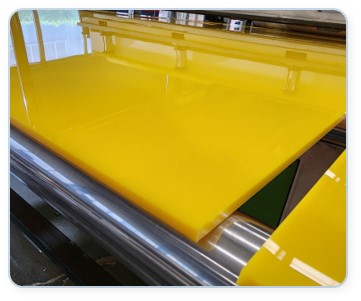
Can You Thermoform HDPE?
Yes, with caveats. HDPE is a semi-crystalline polymer, which means its softening window is narrow compared with amorphous resins. Heat it too little and it tears; heat it too long and it sags badly under gravity. Crystallization is also fast on cooling, so dwell time in the mold matters.
The practical verdict: HDPE thermoforming is feasible for thin-gauge sheet and shallow draws. Deep-draw, high-detail parts are better suited to a PP sheet — PP’s wider forming window makes it the more forgiving thermoforming resin.
Forming starts with a well-extruded blank — see our HDPE sheet extrusion guide for how sheet stock is made.
HDPE Thermoforming Temperature & Key Parameters
Hitting the right temperature range is the single most critical factor in HDPE thermoforming.
| Parameter | Typical Value |
|---|---|
| Softening onset | ~120–135 °C |
| Forming window | ~150–180 °C |
| Avoid above | 185 °C (yellowing) |
| Mold temperature | 40–60 °C |
| Linear shrinkage | 1.5–4% |
HDPE has low thermal conductivity, so dual-sided infrared heating is essential for a uniform temperature. Uneven heating leads to thin spots and tearing. Keep sheet thickness to 0.5–3 mm for the best balance of heat-through speed and sag control.
HDPE Vacuum Forming vs Pressure Forming
For most HDPE applications, vacuum forming — negative-pressure drape over a female mold — is the right choice. It is low-cost, fast-cycling, and well-matched to HDPE’s narrow forming window.
| Method | Best For | HDPE Fit |
|---|---|---|
| Vacuum forming | Thin sheet, shallow draw | ✓ First choice |
| Pressure forming | Deep draw, fine texture | Limited — adds sag risk |
| Mechanical forming | Thick sheet, small runs | Niche use only |
Pressure forming keeps the sheet at elevated temperature longer and adds tooling cost — both work against HDPE. Stick with vacuum forming and rapid mold cooling to lock dimensions before shrinkage compounds.
Step-by-Step HDPE Thermoforming Process
Cut to size. Start with flat, dry sheet — moisture trapped in the blank can cause surface bubbles.
Heat evenly. Use dual-sided infrared heaters. Bring the sheet to 150–180 °C uniformly; watch for the gloss change that signals adequate softening.
Form quickly. Drape or clamp over the mold and apply vacuum immediately. HDPE sags fast once fully softened.
Cool under vacuum. Hold negative pressure while the mold cools the part. Target mold surface temperature at 40–60 °C.
Trim. Use a CNC router or steel-rule die. Allow for the 1.5–4% shrinkage in your trim allowances.
Inspect. Check wall thickness uniformity, corner thinning, and any whitening that signals over-stress.
Choosing Thermoformable HDPE Sheet
Not all HDPE sheet thermoforms equally. Extruded sheet gives more consistent gauge and better surface quality than compression-molded slab — gauge uniformity directly controls heating evenness.
For most forming jobs, a standard HDPE sheet offers the right balance of cost and formability. Select a high-density polyethylene sheet with consistent gauge for uniform heating and predictable draw.
For formed liners and chemical tanks, HDPE PE100 sheets deliver the melt strength the process needs. Outdoor formed parts hold up better with a UV-stabilized marine grade HDPE sheet.
Look for a supplier that offers food-grade and UV-stable certification, thin-gauge cutting service, and consistent lot-to-lot MFI — MFI variation shifts your forming temperature window between batches.
Frequently Asked Questions
1. Can HDPE be thermoformed?
Yes. HDPE thermoforming is viable for thin sheet and shallow draws. Precise temperature control and vacuum forming are essential.
2. What temperature is needed to thermoform HDPE?
The forming window is roughly 150–180 °C. Dual-sided infrared heating ensures the sheet reaches this range uniformly.
3. Is vacuum forming better than pressure forming for HDPE?
Yes, for most applications. Vacuum forming is faster, lower-cost, and limits high-temperature dwell time — reducing sag and dimensional error.
4. What HDPE thickness is best for thermoforming?
0.5–3 mm thin-gauge sheet. Thicker sheet heats unevenly and sags more under its own weight before forming is complete.
5. How do I choose a thermoformable HDPE sheet supplier?
Look for consistent gauge, certified grades (food-grade, UV-stable, PE100), and a supplier offering cutting and sizing services to reduce blank-prep time.