
A polypropylene cutting board is one of the most common food-contact applications for PP sheet. Commercial kitchens, meat processing plants, and food factories all demand cutting surfaces that meet FDA food-safety standards, resist deep knife marks, and withstand high-temperature sanitation cycles.
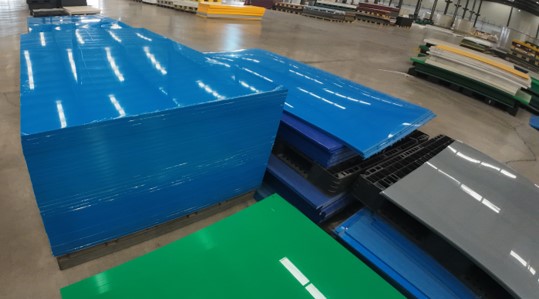
This guide is written from a sheet manufacturer’s perspective. It explains why PP — rather than HDPE, PE, or wood — is the preferred base material for food-grade cutting boards. It also outlines how to select the right grade, thickness, and size for your application.
What Is a Polypropylene Cutting Board — and Why PP?
A polypropylene cutting board is made by cutting or CNC-machining a PP sheet to the required dimensions. The material choice matters because not every plastic performs equally in food environments.
| Property | PP | HDPE | Wood |
|---|---|---|---|
| FDA food contact | ✓ | ✓ | Variable |
| Knife-mark resistance | Good | Very good | Poor |
| High-temp dishwasher | ✓ | Limited | ✗ |
| Water absorption | <0.01% | <0.01% | High |
PP is non-porous, has near-zero water absorption, and resists most cleaning chemicals. These properties make it a natural choice for food-contact surfaces that require frequent sanitation.
Food-Safe PP Sheet Grades & Compliance
Not all PP sheet is food-grade. The grades that matter for cutting board fabrication are:
- BPA-free — standard for all food-contact PP.
- FDA 21 CFR 177.1520 — the U.S. compliance benchmark for olefin polymers in food contact.
- EU 10/2011 — migration limits for food-contact plastics in European markets.
For high-temperature sanitation or heavy-duty cutting, homopolymer PP sheet (PPH) offers higher rigidity and heat resistance than standard copolymer PP.
Commercial kitchens following HACCP protocols also use color-coded cutting boards — red, blue, yellow, and green — to separate raw and cooked food zones. PP sheet is available in multiple colors to support this system and reduce cross-contamination risk.
PP Sheet Specifications for Cutting Board Fabrication
Choosing the right polypropylene sheet starts with thickness:
| Thickness | Typical Use |
|---|---|
| 1/4" (6 mm) | Light-duty prep |
| 1/2" (12 mm) | Standard commercial kitchen |
| 3/4" (19 mm) | Heavy butchery |
| 1" (25 mm) | Industrial food processing |
Standard sheets come in 4×8 ft panels. For custom projects, cut-to-size PP is available for non-standard dimensions. The full PP sheet sizes guide lists all available stock dimensions.
Surface finish also matters. Textured surfaces improve grip during cutting. Smooth surfaces are easier to sanitize. Your choice depends on whether slip-resistance or cleanability is the higher priority.
Commercial & Industrial Applications
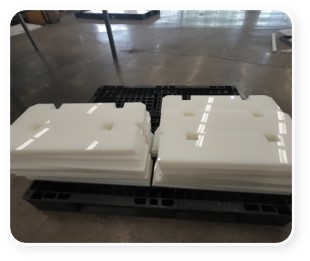
PP sheet serves as the base material for cutting boards across a wide range of food environments:
- Commercial kitchens — daily prep work, dishwasher-safe cycling
- Butcheries & meat processing — heavy knife work, HACCP color coding
- Seafood processing — salt-water and acid resistance
- Food-grade conveyor liners — a natural extension of the same food-contact PP sheet
For bulk fabrication or OEM supply, sourcing directly from a PP sheet board manufacturer gives you full control over grade, color, thickness, and sheet size — lowering per-unit material cost compared to purchasing finished boards.
Frequently Asked Questions
1. Is a polypropylene cutting board safe for food?
Yes. Food-grade PP meets FDA 21 CFR 177.1520 standards. Its non-porous surface does not absorb moisture or harbor bacteria, making it one of the safest cutting board materials available.
2. Is polypropylene better than HDPE for a cutting board?
PP offers better heat resistance and rigidity. HDPE is slightly softer and more knife-friendly. For high-temperature dishwasher cycles or structural rigidity, PPH is the stronger choice. For very heavy knife work, HDPE may be preferred.
3. What thickness of PP sheet should a commercial cutting board use?
Most commercial kitchens use 1/2" (12 mm) as a standard. Butchery stations and industrial plants typically require 3/4" to 1" for load-bearing durability.
4. Can polypropylene cutting boards go in the dishwasher?
Yes. PP handles continuous temperatures up to approximately 120 °C (248 °F). This makes it compatible with commercial dishwasher and autoclave sanitation cycles.
5. Where can I source food-grade PP sheet for cutting board fabrication?
Zhihong Plastics supplies food-grade PP and homopolymer PP sheet.