

When buyers ask for a polyethylene sheet price, they usually expect a single number. In reality, a sheet quotation is the sum of at least six variables — resin grade, density, thickness tolerance, additive package, sheet format and order volume — plus packaging and freight. Two suppliers can quote the same “4×8 HDPE sheet” and differ by 30% simply because one is quoting virgin resin with ±0.2 mm tolerance and the other is quoting recycled material with a loose ±5% band.
This guide breaks down how extruded polyethylene and polypropylene sheet pricing is actually built, so you can compare offers on equal terms and reduce landed cost without sacrificing performance.
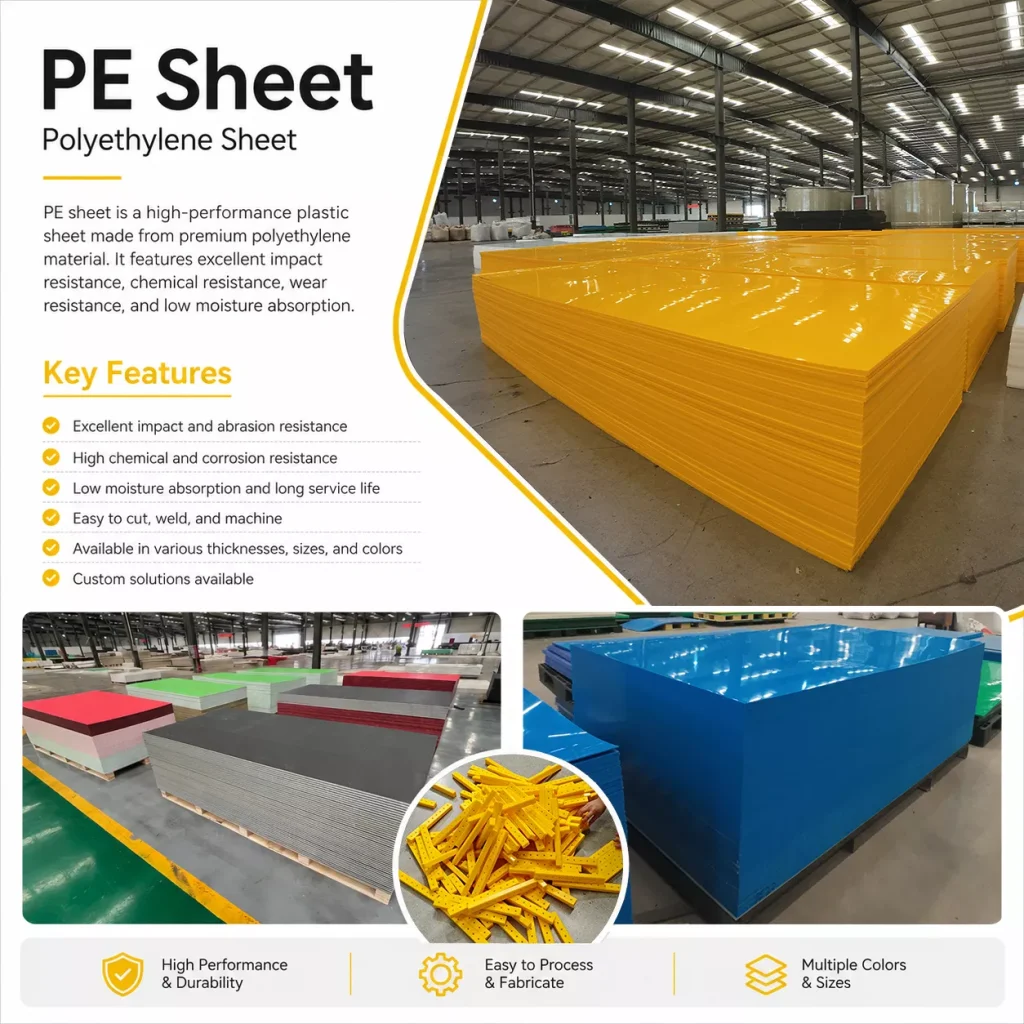
How Polyethylene Sheet Price Is Really Calculated
Extruded plastic sheet is sold by weight, not by area. Even when a supplier quotes “per sheet” or “per square meter,” the underlying math is weight-based:
Sheet weight (kg) = Length (m) × Width (m) × Thickness (m) × Density (kg/m³)
For HDPE, density is approximately 950 kg/m³. For polypropylene, roughly 910 kg/m³. UHMW-PE (UPE) sits near 930–940 kg/m³.
A worked example — a 1220 × 2440 mm HDPE sheet at 10 mm thickness:
1.22 × 2.44 × 0.010 × 950 = 28.3 kg
At a delivered price of USD 1.90/kg, that sheet costs roughly USD 53.80 before freight. Change nothing but thickness — 20 mm instead of 10 mm — and the sheet weight doubles to 56.6 kg. This is why thickness, not sheet count, is the single largest driver of your invoice.
Before you compare quotes, run your own numbers through a plastic sheet weight calculator. If a supplier’s quoted sheet weight is 8% below the theoretical value, they are shipping you an under-gauge sheet — and you are paying for material that isn’t there.
Seven Factors That Move Your Quotation
- Resin grade and origin.Virgin PE100 or certified food-grade HDPE carries a premium of 10–25% over standard extrusion grade. Domestic Chinese resin is typically cheaper than imported Korean, Middle Eastern or European grades of the same MFI.
- Virgin vs. recycled content.Regrind or recycled HDPE can cut material cost by 20–40%, but brings inconsistent color, reduced impact strength, possible contamination and unpredictable weld quality. For structural, marine or potable-water applications, recycled content is a false economy.
- Thickness tolerance.A tight ±0.2 mm tolerance requires slower line speed, better gauge control and higher scrap rates. Loose tolerance sheet is cheaper but often runs deliberately thin.
- Additive package.UV stabilizers, antistatic agents, flame retardants and colored masterbatch all add cost. Flame-retardant PE or PP typically prices 30–60% above natural grade because halogen-free FR systems are expensive and loading levels are high.
- Color.Natural white/black is cheapest. Custom colors, color-matched batches, and dual-color or color-core sheets require dedicated changeovers and carry both a price premium and a minimum run quantity.
- Surface finish.Smooth, matte, textured, diamond-embossed or skid-resistant surfaces each require different calender rolls or embossing tooling.
- Order volume.This is the most underrated lever. A full 20′ container of a single specification will always beat mixed-spec LCL pricing, because extrusion lines earn their margin on uninterrupted runs.
Indicative Price Ranges (FOB China, Reference Only)
|
Material |
Typical Grade |
Indicative Range (USD/kg) |
Notes |
|
HDPE sheet |
Standard extrusion, natural/black |
1.55 – 2.20 |
Baseline product |
|
HDPE sheet |
PE100, certified |
1.90 – 2.60 |
Pressure/structural grade |
|
Dual-color / color-core HDPE |
Marine board |
2.30 – 3.20 |
Multi-layer co-extrusion |
|
PP sheet (homopolymer) |
Natural/grey |
1.50 – 2.10 |
Chemical tank grade |
|
PP sheet (copolymer) |
Higher impact |
1.65 – 2.30 |
Better low-temp toughness |
|
Flame-retardant PP/PE |
UL94 V-0 class |
2.60 – 4.00 |
Additive-driven |
|
UHMW-PE (UPE) |
3–5 million MW |
3.20 – 5.50 |
Wear-resistance premium |
These ranges move with global resin markets, oil prices, freight rates and exchange rates. Treat them as a sanity check, not a fixed price list. Always request a written quotation valid for a stated period — typically 15 to 30 days.
Polypropylene Sheets 4×8 Price: What to Expect
The 4×8 foot (1220 × 2440 mm) format is the global standard because it matches plywood dimensions, pallet footprints and CNC bed sizes. Knowing polypropylene sheets 4×8 price requires the same weight-based logic:
|
Thickness |
Sheet Weight (approx.) |
Indicative Sheet Price (USD) |
|
3 mm |
8.1 kg |
13 – 18 |
|
5 mm |
13.5 kg |
21 – 30 |
|
10 mm |
27.1 kg |
42 – 58 |
|
15 mm |
40.6 kg |
63 – 88 |
|
20 mm |
54.2 kg |
84 – 116 |
|
25 mm |
67.8 kg |
105 – 145 |
PP sheet is generally 3–8% cheaper per kilogram than equivalent HDPE, and because PP is roughly 4% less dense, a PP sheet of identical dimensions weighs less — giving a compound saving on both material and freight. For detailed format and pricing options, see our dedicated polypropylene sheets 4×8 price reference.
Note the trade-off: PP offers superior chemical resistance and a higher continuous service temperature (up to about 100°C), while HDPE delivers better impact strength at low temperatures and easier machining. Choosing PP purely to save 5% is a mistake if your application sees sub-zero impact loads.
The Hidden Costs Buyers Forget
Freight and volumetric efficiency. Plastic sheet is bulky. A 20′ container holds roughly 18–20 tonnes of thick sheet but “cubes out” long before that with thin sheet. Ask your supplier to optimize the loading plan — mixing thick and thin specifications can add 15–20% more product to the same container.
Cutting waste. If your parts nest poorly in a 1220 × 2440 sheet, your effective material cost may be 25% higher than your purchase price. Custom widths — 1500 mm, 2000 mm or 2500 mm — often eliminate that waste entirely and pay for themselves despite a small per-kg premium.
Machining and fabrication. Under-gauge or warped sheet slows CNC routing, causes vacuum-table failures and increases rejects. Flatness is a cost factor, not a cosmetic one.
Replacement cycles. A ground protection mat that lasts three seasons instead of one is 200% cheaper in total cost of ownership, regardless of purchase price.
Eight Practical Ways to Reduce Landed Cost
- Consolidate specifications.Reduce your SKU count so each run is longer.
- Order full containers.FCL pricing beats LCL by a wide margin per kilogram.
- Standardize on natural or black.Skip custom colors unless branding demands it.
- Right-size the thickness.Many buyers over-specify by 5 mm out of caution. Verify with load calculations.
- Request cut-to-size.Let the factory absorb offcuts into their regrind stream instead of paying to ship waste.
- Buy counter-cyclically.Resin prices soften seasonally; forward contracts can lock in favorable rates.
- Specify tolerance precisely.Don’t pay for ±0.2 mm on a non-critical liner.
- Audit actual sheet weight on arrival.Weight verification is the fastest way to detect a cheap quote hiding thin material.
RFQ Checklist for Accurate Quotations
To receive a comparable quotation the first time, supply:
- Material and grade (HDPE, PE100, PP-H, PP-C, UPE)
- Exact dimensions and thickness, with tolerance
- Color and surface finish
- Additive requirements (UV, FR, antistatic, food contact)
- Quantity in kg, sheets or containers
- Incoterm (FOB, CIF, DDP) and destination port
- Required certifications and test reports
Ambiguity always produces a conservative — meaning higher — price.
Why Source From Zhihong
Founded in 2012, Hebei Zhihong Plastic Products Manufacturing Co., Ltd. operates dedicated extrusion lines for HDPE, PP and UHMW-PE sheet at Songmen Provincial Chemical Industrial Park, Wuqiao County, Cangzhou, Hebei. Direct factory supply means no trading-company markup, transparent weight-based pricing and full control over resin selection and thickness calibration. Our sheets serve customers across more than twenty Chinese provinces and throughout Southeast Asia.
Explore our full PE sheet series for specifications, available thicknesses and formats — or send your drawings and target volume for a same-week quotation.
If you are budgeting a project, our cost of HDPE sheets guide covers material, size, and quantity pricing.



