

When selecting a plastic sheet for your project, the HDPE vs PP decision comes up more often than almost any other material comparison. Both are commodity polyolefins, both are widely available, and both perform well across a broad range of industrial applications. Yet their structural differences lead to very different performance profiles. This guide breaks down exactly where each material wins.
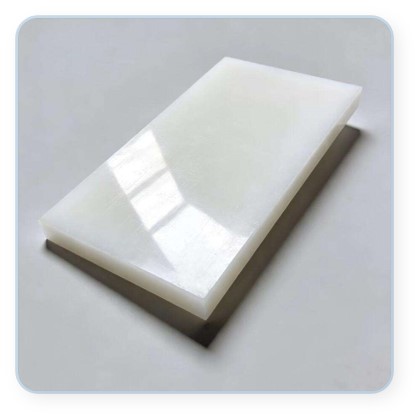
What Are HDPE and PP?
High-density polyethylene (HDPE) is a linear-chain polymer with tightly packed molecular chains, giving it exceptional toughness and impact resistance. Polypropylene (PP) adds a methyl side group to every other carbon in the backbone. That small structural change raises its stiffness and heat resistance — but costs it cold-weather toughness.
Both materials are considered engineering plastic building blocks used in sheet, rod, and tube form across food processing, chemical handling, and industrial fabrication.
HDPE vs PP Property Comparison (At a Glance)
| Property | HDPE | PP |
|---|---|---|
| Density | 0.94–0.97 g/cm³ | 0.90–0.91 g/cm³ |
| Continuous use temp. | ~80°C | ~100°C |
| Melting point | ~130°C | ~160–165°C |
| Low-temp. impact (Tg) | Tough to −110°C | Brittle near 0°C |
| Rigidity / toughness | Softer, higher elongation | Stiffer, more brittle |
| Water absorption | <0.01% | <0.03% |
| Fatigue / living hinge | Moderate | Excellent |
| Chemical resistance | Acids, bases, solvents | Acids, bases; better vs. hot organics |
| Welding | Hot gas / butt welding | Hot gas / extrusion welding |
| Cost | Low (commodity) | Slightly higher |
Heat Resistance: PP Runs Hotter
For high-temperature applications, polypropylene is the clear winner. PP handles continuous service up to ~100°C — meaning it is safe in boiling-water environments. Its melting point sits at ~160–165°C. HDPE softens at around 80°C continuous use, with a melting point near 130°C.
If your parts will see steam cleaning, hot-liquid contact, or elevated ambient temperatures, choose our polypropylene sheet.
Low-Temperature Toughness: HDPE Wins Below Freezing
This is where HDPE pulls decisively ahead. Its glass transition temperature sits near −110°C, so it stays tough and impact-resistant in freezing or cryogenic environments. Homopolymer PP begins to embrittle at approximately 0°C — a serious liability for cold-storage, outdoor winter, or refrigerated-line applications.
For any application exposed to sub-zero conditions, HDPE sheet is the safer, more reliable choice.
Chemical, Moisture & Fatigue Resistance
Both materials have very low water absorption — under 0.03% — making them excellent for wet or humid environments. Neither swells, warps, or degrades with moisture exposure alone.
On chemical resistance, both resist most acids and alkalis well. PP has a slight edge at elevated temperatures against organic solvents. Where PP clearly leads is fatigue resistance: its molecular structure supports living hinges and repeated flex-cycles without cracking, which is why it dominates in hinge-integrated components.
For more on how PP behaves under modified formulations, see our comparison of flame retardant PP versus standard grades.
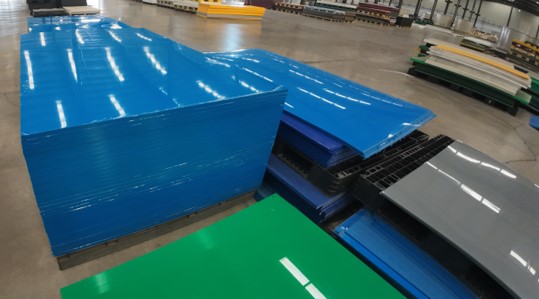
Fabrication & Welding — Never Cross-Weld
Both materials can be cut, machined, and thermoformed. However, their thermoforming windows differ: HDPE processes between 145–160°C, while PP requires 160–175°C.
The single most critical rule: never weld HDPE to PP. Their different crystal structures produce cold peel-off welds with near-zero weld factors. The joint will fail. Each material must be welded only to itself using hot-gas or extrusion welding techniques with matching filler rod.
This is also why HDPE vs PP is not like HDPE vs UHMWPE — UHMWPE and HDPE share the same polymer family and can be handled more similarly in fabrication.
HDPE vs PP Cost & Price
Both are commodity thermoplastics, so neither carries a significant price premium over the other. PP is typically priced slightly higher than HDPE due to its more complex polymerization process. That said, the difference is rarely the deciding factor in an application.
Choose by technical fit — not by raw price. Buying the wrong material and replacing it costs far more than any unit price difference.
Applications & Which to Choose
Use this simple decision framework:
- Temperature above 80°C → Choose PP
- Sub-zero or freezing conditions → Choose HDPE
- Living hinges or high fatigue cycles → Choose PP
- Impact-critical or outdoor cold-climate parts → Choose HDPE
- Cost is the primary constraint → Both are comparable; HDPE is slightly lower
In food processing, HDPE dominates cutting boards and tank liners. PP leads in chemical tank components, sterilizable equipment, and parts with integral hinges.
Frequently Asked Questions
1. Is HDPE or PP stronger?
PP homopolymer is stiffer (higher flexural modulus), but HDPE is tougher with higher elongation and far better low-temperature impact resistance.
2. Which plastic handles heat better, HDPE or PP?
PP: continuous use up to ~100°C (boiling-water safe) versus ~80°C for HDPE, with a higher melting point (~160°C vs ~130°C).
3. Which is better for cold or freezing conditions?
HDPE. It stays tough down to about −110°C, while homopolymer PP embrittles near 0°C.
4. Can you weld HDPE to PP?
No. Their different crystal structures produce cold peel-off welds with near-zero weld factor — never cross-weld the two materials.
5. Is HDPE or PP cheaper?
Both are commodity thermoplastics and similarly priced, with PP usually slightly higher; choose by application requirements rather than raw price.



