

Choosing between HDPE and UHMWPE is one of the most common headaches for engineers and procurement managers. Both materials belong to the polyethylene family. Both look and feel similar on a shop floor. Yet UHMWPE often costs 40% to 80% more per kilogram than HDPE. Why?
When comparing hdpe vs uhmwpe, the answer lies in molecular structure. HDPE is the all-purpose workhorse — easy to thermoform, easy to weld, and cost-effective for structural fabrication. It shows up everywhere, from storage tanks to shipping pallets, largely because of its versatility as one of the standard density polyethylene sheets used across industry. UHMWPE, on the other hand, is the specialist. It cannot be thermoformed or welded easily, but it dominates in extreme wear environments where nothing else survives.
This guide breaks down the real engineering differences so you can specify the right material the first time.
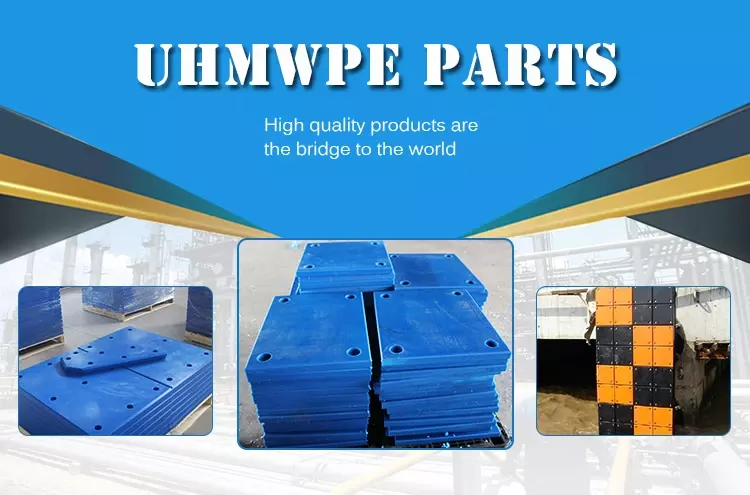
Molecular Weight: The Invisible Giant
The core difference is molecular weight. HDPE molecules typically range from 300,000 to 500,000 g/mol. Their chains are relatively short, so the material flows easily when melted.
UHMWPE is a different story. Its molecular weight climbs to 3,000,000–9,200,000 g/mol. Picture a dense mesh of steel wire instead of loose thread. This tangle gives UHMWPE its legendary toughness — but it also means the material barely flows at all when heated.
That “zero melt flow” trait changes everything about manufacturing. HDPE can be extruded continuously through standard screws. True UHMWPE behaves like an extremely viscous rubber block. It must be shaped through slow, high-pressure compression molding under massive hydraulic presses, sometimes for hours at a time.
Wear Resistance and Impact Strength
This is where UHMWPE earns its reputation. In ASTM G65 sand-slurry abrasion testing, with carbon steel set at a wear index of 100, HDPE scores around 200–250. UHMWPE scores just 15–20. Lower numbers mean better wear resistance, so UHMWPE outlasts HDPE by roughly four times and outperforms carbon steel by six times.
Friction tells a similar story. UHMWPE has a coefficient of friction near 0.10–0.12, second only to PTFE. HDPE sits closer to 0.20–0.25.
Cold-weather impact resistance is another key differentiator. At -40°C, HDPE’s notched impact strength drops noticeably. UHMWPE, tested under ASTM D256, typically shows “no break” even at these temperatures. That resilience makes it the natural choice for heavy-duty applications like impact liners and structural bumpers, where heavy duty thermoplastic plates need to survive constant abuse without cracking.
Machining, Welding, and Fabrication
Machinability differs too. HDPE is slightly harder (Shore D 68) and machines cleanly, with chips that break away easily and tight tolerances that are simple to hold. UHMWPE is tougher and more elastic (Shore D 62). It tends to produce long, stringy chips that don’t break cleanly, so machinists need sharp tools with a large rake angle to avoid material springback.
These properties matter most when producing precision components like sprockets, star wheels, and custom wear blocks — the kind of precision machined industrial parts found throughout chemical and material-handling operations.
Fabrication flexibility also diverges sharply. HDPE welds beautifully. Fabricators use extrusion welding or butt-fusion to join large panels into seamless tanks and containment structures. UHMWPE, because its molecules barely move when heated, cannot be welded this way. Mechanical fastening — bolts and brackets — is the standard joining method instead. UHMWPE also can’t be vacuum-formed, since there’s no melt flow to stretch across a mold.
Data Comparison and Weight Calculation
Here’s a side-by-side snapshot of key properties:
- Density:HDPE 0.95–0.96 g/cm³ vs. UHMWPE 0.93–0.94 g/cm³
- Tensile yield strength:HDPE 26–30 MPa vs. UHMWPE 20–24 MPa
- Flexural modulus (stiffness):HDPE 1,100–1,400 MPa vs. UHMWPE 700–900 MPa
- Wear resistance:UHMWPE outperforms HDPE by 4–5x
- Cost per kilogram:UHMWPE runs 40–70% higher than HDPE
Since imperial drawings and metric sheet stock don’t always line up cleanly, converting dimensions first can save costly ordering mistakes:
Once dimensions are confirmed, weight and cost estimates come next. Density differences between the two materials directly affect per-sheet weight and shipping cost:
For a full breakdown across sheet sizes and thicknesses, procurement teams can run exact figures through the plastic sheet weight calculator before finalizing a container order.
Which Material Should You Choose?
Pick HDPE when: you need welded tanks or chemical containment vessels, vacuum-formed trays, food-grade cutting boards, or structural stiffness on a tight budget.
Upgrade to UHMWPE when: you’re lining chutes exposed to constant abrasive impact, building conveyor guides and wear strips, protecting dock fenders from heavy repeated collisions, or operating in sub-zero environments where brittleness is a real risk.
Still weighing the broader polyolefin family? Our HDPE vs PP comparison lays out how each material handles heat, sub-zero toughness, and weldability.
Material selection within the wider polyethylene family goes beyond just HDPE and UHMWPE, too — variables like UV stabilization and marine exposure matter. These are covered in more detail in dedicated polyethylene grade selection guides.
Frequently Asked Questions
1. Can HDPE replace UHMWPE on conveyor wear strips to cut costs?
Only in light-duty, low-speed applications with a tight budget. On continuous high-speed lines, HDPE wears out roughly four times faster and increases motor load due to higher friction. The material savings are usually outweighed by more frequent replacement and downtime.
2. Why can’t UHMWPE be injection molded or thermoformed?
Its molecular weight (3–9 million g/mol) means the melt flow rate stays near zero even above its melting point. The material behaves like a dense, non-flowing gel rather than a liquid, so it must be compression molded instead.
3. Which is stiffer for structural load-bearing: HDPE or UHMWPE?
HDPE. Its flexural modulus (1,100–1,400 MPa) is notably higher than UHMWPE’s (700–900 MPa), giving it less deflection under static load.
4. How can buyers verify a sheet is genuine UHMWPE and not cheap HDPE?
Check the surface feel — UHMWPE has a distinctly waxy texture. A small burn test also works: HDPE drips like melting wax, while UHMWPE chars without dripping. Lab testing for melt flow rate (below 0.1 g/10min) is the most definitive method.
5. Can UHMWPE sheets be welded using standard HDPE extrusion guns?
Not reliably. The molten HDPE filler can’t bond properly with UHMWPE’s non-flowing surface, resulting in weak joints prone to peeling. Mechanical fastening is the safer choice.
Choosing the right material isn’t about picking the most expensive option — it’s about matching wear demands, structural needs, and budget precisely. Send your CAD drawings to our engineering team for a free material recommendation and container-load pricing.
For the polyethylene family basics first, see our LDPE vs High-Density Polyethylene comparison.
If you are weighing HDPE against an engineering plastic rather than UHMWPE, see our HDPE vs Delrin guide.



