

If you have ever shopped for a polyethylene sheet and seen two quotes — one for “HDPE” and one for “marine grade HDPE” at nearly double the price — you have probably asked the obvious question: is it really the same plastic with a marketing label attached? The short answer is no. The longer answer is that the base polymer is closely related, but the formulation, surface, color system, and quality control behind a genuine marine board are engineered for a completely different service life. Knowing the difference between marine grade HDPE vs HDPE will save you money on projects that don’t need it, and save you from premature failure on projects that do.
What Standard HDPE Sheet Is
High density polyethylene is a semi-crystalline thermoplastic with a density typically between 0.94 and 0.96 g/cm³. That tight molecular packing is what gives high density polyethylene sheets their signature combination of properties: excellent chemical resistance, very low moisture absorption, good impact strength even at low temperatures, a naturally low coefficient of friction, and easy machinability with standard woodworking or CNC tooling.
Standard extruded HDPE sheet is generally supplied in natural (translucent white), black, or a limited range of solid colors. It is the workhorse material for fabrication shops, food processing plants, chemical tanks, cutting boards, wear strips, chute liners, and industrial guarding. A basic high density polyethylene HDPE sheet is usually produced from virgin or blended resin with minimal additive packages — perhaps a small amount of carbon black in the black grades for basic UV screening, and antioxidants to survive the extrusion process itself.
That is the key point: standard HDPE is optimized for mechanical performance and cost. It is not specifically formulated to sit outdoors in salt spray and full sunlight for fifteen or twenty years without changing color, chalking, or becoming brittle.
What Makes a Sheet “Marine Grade”
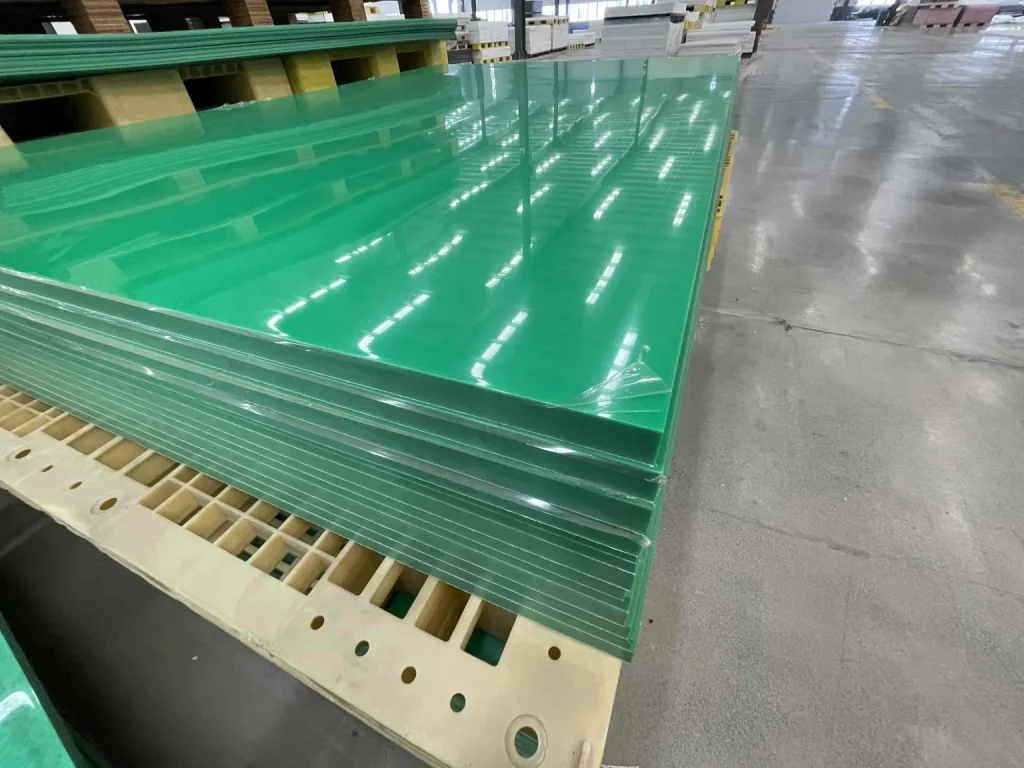
Marine grade HDPE — often called marine board or HDPE marine board — starts from the same polymer family but adds several deliberate engineering layers.
- Heavy UV stabilization. This is the single biggest technical difference. Marine board carries a substantially higher loading of UV absorbers, hindered amine light stabilizers (HALS), and thermal antioxidants. Standard sheet might hold up for a couple of seasons outdoors before you notice fading and surface chalking. A properly formulated marine grade sheet is designed for continuous exposure, and reputable producers will quote UV performance in terms of accelerated weathering hours or years of guaranteed color retention.
- Through-body color and color-core construction. Manufacturers pigment marine board entirely throughout. Therefore, scratches, gouges, or saw cuts never reveal a different-colored substrate. Additionally, makers often construct marine boards as color-core sheets. Specifically, they bond colored cap layers onto a white core. Consequently, CNC routing easily exposes contrasting text and graphics for signage. However, standard HDPE rarely offers this useful dual-layer construction.
- Matte or orange-peel textured surfaces. Marine sheet is typically embossed with a low-gloss, slightly textured finish. This does three useful things: it hides scratches from normal use, it reduces glare on boat decks and helm stations, and it provides better grip when wet. Standard HDPE is more commonly supplied smooth or lightly textured on one side only.
- Tighter thickness and flatness tolerances. Marine board is frequently fabricated into finished visible parts — hatch covers, seat bases, tackle stations, rub rails, fish boxes. Warping or thickness variation shows immediately. Marine grade production runs therefore hold tighter dimensional control and are cooled more carefully to reduce internal stress, which matters enormously when the part is later machined asymmetrically.
- Higher-purity resin selection. Genuine marine board uses virgin resin with consistent melt flow, not regrind or wide-spec blends. Consistency here drives predictable machining behavior and long-term dimensional stability.
Side-by-Side: Where the Two Diverge in Service
|
Consideration |
Standard HDPE Sheet |
Marine Grade HDPE |
|
Primary design goal |
Cost-effective mechanical performance |
Long-term outdoor appearance plus performance |
|
UV package |
Minimal to moderate |
Heavy, engineered for continuous exposure |
|
Color |
Natural, black, limited solids |
Wide palette, through-body, color-core options |
|
Surface |
Smooth or single-side texture |
Matte/orange-peel both sides, low glare |
|
Typical outdoor life |
2–5 years before visible degradation |
10–20 years with color retention |
|
Relative cost |
Baseline |
1.5–2.5× baseline |
Mechanically, the two are very similar. Tensile strength, hardness, and impact resistance figures for marine board and standard HDPE overlap heavily. Marine grade is not stronger in any dramatic way — it is durable in a different dimension, namely resistance to environmental degradation and cosmetic wear. That distinction is what most buyers get wrong.
Choosing Correctly
Ask yourself three questions.
1. Is the part exposed to sunlight for years?
If yes, specify marine grade — or at minimum a UV-stabilized black HDPE. Outdoor furniture, dock hardware, playground components, planter boxes, signage, and rooftop equipment all belong in this category.
2. Does appearance matter?
If the part is a visible finished surface where fading, chalking, or a scratch showing white would be unacceptable, marine grade is the right call. If the part is a hidden liner, a wear pad inside a chute, or a machine guard in a factory, standard sheet is entirely adequate and you are simply paying for stabilizers you will never use.
3. Is there salt, chlorine, or constant wet/dry cycling?
HDPE is fundamentally hydrophobic and essentially immune to saltwater corrosion in both grades, so this alone doesn’t force the upgrade — but it usually accompanies UV exposure, which does.
Conversely, there are plenty of applications where paying the marine premium is genuinely wasteful. Indoor cutting boards, chemical tank baffles, conveyor wear strips, packaging dies, and pipe supports all perform identically in standard sheet. This is where a clear understanding of high density polyethylene uses across industries helps a purchasing team specify intelligently rather than defaulting to the most expensive option.
Fabrication Notes That Apply to Both
Both grades cut cleanly with carbide-tipped blades, rout well at high spindle speed with low feed, and drill without chipping. Neither accepts paint or adhesive without surface treatment — flame treating, corona treatment, or specialized polyolefin primers are required, and mechanical fastening or plastic welding is almost always the better route. Both have a relatively high coefficient of thermal expansion, roughly 1.2–2.0 mm per meter per 10 °C, so slotted or oversized fastener holes are essential on any panel longer than about a meter. This single detail causes more field failures than material selection ever does.
Thickness, Sizes, and Sourcing
Marine board is most commonly stocked from 6 mm through 25 mm, with 12 mm and 19 mm dominating boat and dock fabrication. Standard sheet ranges much wider — from 1 mm liners up to 100 mm or more for machined blocks and bearing pads. Common panel sizes are 1220 × 2440 mm (4×8 ft) and 1500 × 3000 mm, with custom cut-to-size available from most extruders.
When sourcing, ask specific questions: What is the UV stabilizer loading and the accelerated weathering test result? Is the color through-body or capped? Is the resin virgin or blended? What are the thickness and flatness tolerances? A supplier who answers precisely is worth more than one who quotes a lower price. Manufacturers producing both a general-purpose high density polyethylene HDPE sheet line and a dedicated marine grade HDPE sheet line can usually advise honestly on which grade your project actually requires.
Marine grade HDPE and standard HDPE share a polymer backbone but serve different missions. Standard sheet delivers chemical resistance, toughness, and machinability at the lowest cost per square meter. Marine grade adds heavy UV protection, through-body color, low-glare texture, and tighter tolerances so that a part still looks and performs correctly after a decade in the sun and salt. Specify by exposure and appearance requirements — not by habit — and you will get the right material at the right price every time.
The same logic that separates marine from standard HDPE also drives HDPE chemical compatibility in saltwater and cleaning-chemical environments.
Put a number on the difference. Marine grade and standard HDPE sit within a few percent of each other in density, so sheet weight is nearly identical at the same thickness – what changes is the UV package, colour and tolerance. Check both against your own dimensions with the plastic sheet weight calculator before you specify.
Related Marine Grade HDPE Guides
Explore these detailed guides for a closer look at specific marine-grade HDPE topics:
- Marine Grade HDPE maintenance and outdoor benefits
- Marine grade HDPE board properties and applications
- HDPE marine board for boat building projects
Deep-Dive Technical Notes
Marine Board Price Per Sheet Explained In Detail
What Affects Marine Board Prices?
Marine board price is influenced by quality. Marine board cost is greater because high-grade materials are more durable and moisture-resistant. Lower-quality materials may lower marine board HDPE sheet prices but suffer performance over time. Labor, machinery, and production costs affect marine board panel price. Boards made utilizing advanced manufacturing methods cost more but are usually better. Shipping distances and logistics costs vary by supplier location. Marine board pricing is also influenced by market demand. When demand spikes without supply, the marine board market price rises. In building and marine industry, seasonal trends also matter. Regional price discrepancies can also result from transportation issues, with urban areas offering more competitive marine board material prices than distant ones. Buyers seeking cost-effective solutions should balance quality and price and investigate wholesale or bulk deals. Understanding these aspects improves marine board cost and project relevance assessments.
How Does Marine Board Thickness Affect Price?
Thickness affects material utilization and structural performance. The marine board cost rises as thicker boards use more raw material. Marine board sheet price and marine board panel price rise, especially for high-demand applications like boat building and heavy-duty construction. For important applications, a 12mm marine board may cost more than a 6mm board due to its strength and endurance. Thicker boards also require stricter manufacturing methods to ensure quality. The price difference between thin and thick marine boards is obvious. Thinner boards are cheaper and ideal for lightweight or secondary uses. The trade-off is their lower load-bearing capability and shorter lifespan than thicker boards. However, a 6mm marine board material price may not exceed structural integrity standards in difficult settings. While bigger boards may increase marine board rates, they perform better and last longer. Understanding these distinctions helps buyers choose the correct board thickness for their project while balancing marine board cost and performance.
Does Material Quality Affect Marine Board Prices?
Due to their superior properties, high-quality materials affect marine board prices. Premium boards for maritime or heavy-duty use use advanced production processes and sturdy materials to increase durability and longevity. Because they function better under extreme conditions such continuous water exposure or pressure, marine board rates are greater. Leading marine board sheet prices reflect their capacity to withstand warping. Standard marine boards have reduced durability, making them suited for less demanding applications at a lower marine board cost. Growing eco-friendliness affects marine board material prices. Sustainable or recycled marine board pricing is environmentally friendly. Green materials offer value while retaining structural integrity and performance. The purpose of a board also affects its marine board panel price. High-load applications may require thicker boards, whereas lighter boards are fine for basic constructions. Comparing options helps users balance project needs and costs. Buyers should compare regular and premium marine board rates to find the greatest fit for their budget and project lifespan.
Tips for Buyer
It depends on material quality, thickness, and purpose. Due to their endurance and features, high-quality boards for demanding applications have higher marine board rates. Customers should compare marine board sheet price and marine board panel price based on dimensions and performance criteria to ensure the product meets project requirements. Checking the marine board wholesale price saves money over the marine board retail price. However, retail purchases are suitable for minimal demands or immediate availability. Keep up with marine board market price trends to make smart purchases, especially during seasonal specials or low demand. A project budget that includes marine board cost, delivery, and additional materials improves financial planning. You can easily compare marine board material prices across providers and get cheap offers online. Buyers should weigh price against quality to avoid sacrificing durability for short-term savings. Users learn which wholesale and retail marine board pricing solutions give the best value while fulfilling budget and performance criteria by comparing them.
Where Can I Get Cheap Marine Boards?
Finding affordable marine boards requires knowing wholesale and retail pricing. For major projects, especially bulk orders, marine board wholesale prices can save a lot. Wholesale providers lower the marine board cost per sheet. Choices may be more suitable for individuals or small enterprises who need fewer quantities. Negotiating directly with local suppliers might it lower. Competitive marine board pricing also depends on online marketplaces. Comparing marine board rates across providers on many websites helps find the best deals. Also, seasonal discounts and promotions make affordable options more accessible. Local hardware stores and marine supply shops are good for immediate purchases, especially if shipping is important. Quality and pricing must be balanced when buying online or in-person. Exploring these routes guarantees you obtain solutions that fit your budget and project demands at a fair marine board price. At Zhihong Plastics, we specialize in providing top-quality marine grade HDPE sheets at competitive prices. Our products are designed to meet the challenges of marine environments, offering durability, water resistance, and long-term performance. We balance quality with affordability to ensure our solutions fit your project needs, whether you require bulk orders or smaller quantities. By leveraging advanced production techniques, we deliver reliable materials tailored to your specifications. Trust Zhihong Plastics for cost-effective and high-performance marine grade HDPE sheets that support your goals and maximize value in every application.



