

FRPP sheet is a fiber reinforced polypropylene panel made by embedding short-cut glass fibers into a polypropylene matrix. This reinforcement significantly boosts tensile strength, rigidity, and heat resistance. At the same time, it retains PP’s hallmark chemical resistance and lightweight nature. Industries rely on it for corrosion-resistant tanks, structural panels, and pump housings.
FRPP (Fiber Reinforced PP) is not the same as FR-PP (flame retardant PP). They share an abbreviation but are entirely different materials.
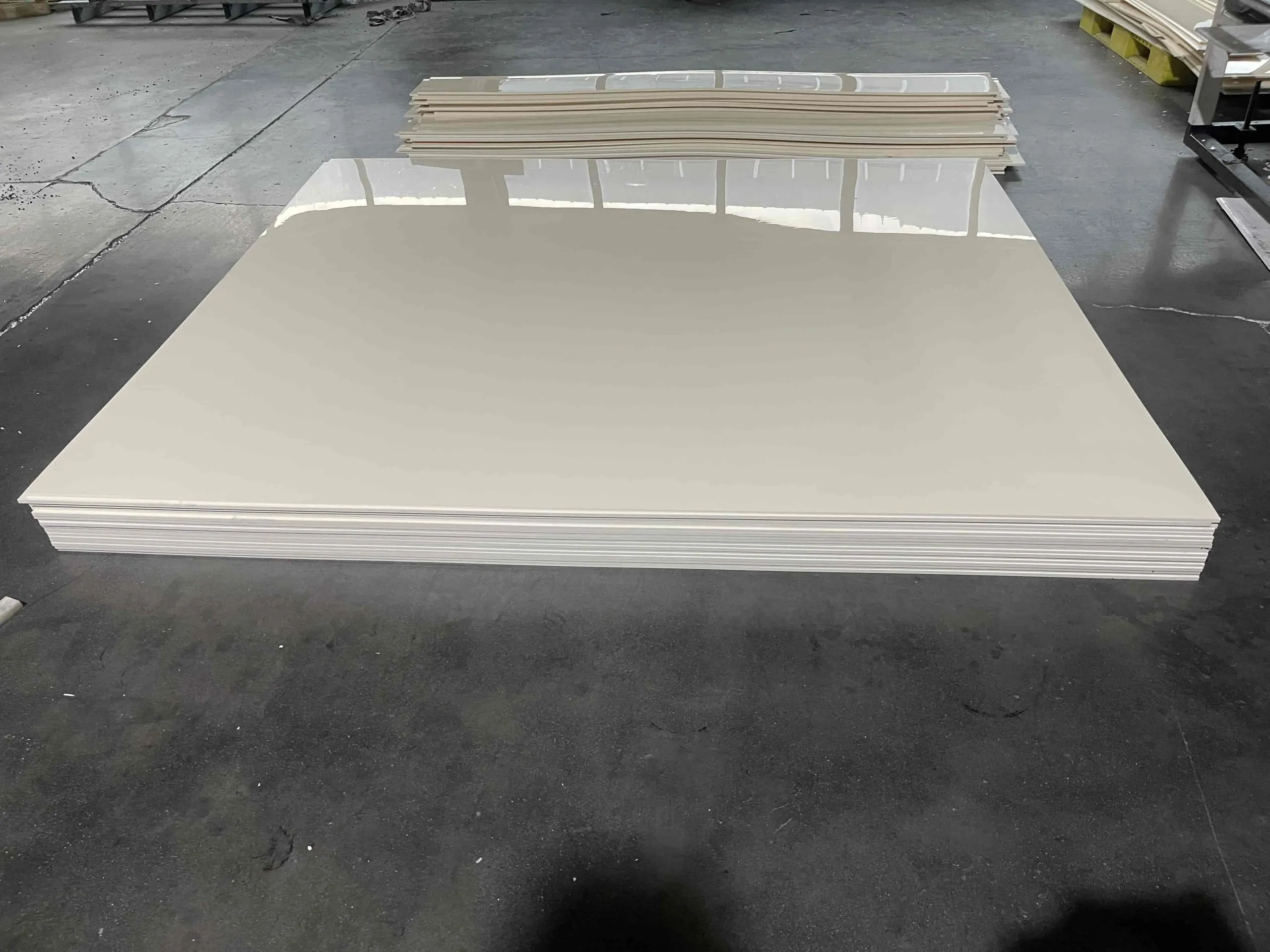
What Is FRPP Sheet?
Glass fibers — typically 20 % to 40 % by weight — are dispersed through a polypropylene base. Under load, the fibers transfer stress away from the softer polymer matrix. The result is a sheet that is two to three times stiffer than unfilled PP.
You will also see this material called glass reinforced polypropylene sheet, glass filled polypropylene, or fiber reinforced polypropylene sheet. All five name variants — FRPP sheet, fiber reinforced polypropylene sheet, fiberglass reinforced polypropylene sheet, glass reinforced polypropylene sheet, and fiber reinforced polypropylene board — describe the same material family.
FRPP is supplied as extruded or compression-molded flat sheet. It can be CNC-machined, thermoformed, and hot-gas welded, just like standard PP sheet.
Important Disambiguation
- FRPP ≠ FR-PP — that is flame retardant PP board, a completely different additive system
- FRPP ≠ FRP/GRP — fiberglass-reinforced polyester resin, a different material family entirely
FRPP vs Standard PP — Key Differences
The table below compares glass reinforced polypropylene with unfilled standard polypropylene sheet.
| Property | FRPP | PP (Unfilled) |
|---|---|---|
| Tensile strength | High (2–3× uplift) | Low |
| Flexural modulus | High | Low |
| Heat deflection temp. | ~135–160 °C | ~100 °C |
| Dimensional stability | Excellent | Moderate |
| Low-temp. impact | Medium | Good |
| Chemical resistance | Good | Excellent |
| Density (g/cm³) | ~1.0–1.2 | ~0.90 |
| Cost | Higher | Lower |
Choose FRPP when you need strength, stiffness, heat resistance, or dimensional stability under sustained load.
Choose unfilled PP when cost is the priority, chemical resistance must be maximized, and loads are light at room temperature. A PPH homopolymer sheet is a useful baseline for that comparison.

Key Mechanical and Chemical Properties
Glass fiber reinforced polypropylene delivers a strong combination of performance characteristics:
- Tensile strength — 60–100 MPa, versus ~30 MPa for unfilled PP, depending on fiber loading
- Young’s modulus — 4,000–7,000 MPa, stiff enough for structural use
- Heat deflection temperature (HDT) — 135–160 °C under 1.8 MPa load
- Chemical resistance — resistant to acids, alkalis, and salt solutions. High glass content slightly reduces resistance to strong hot acids — verify compatibility for your specific medium
- Low creep — dimensional stability under sustained load is a major advantage over unfilled grades
Applications
FRPP sheet is the right choice wherever chemical resistance meets structural demand:
- Corrosion-resistant tanks and liners — pickling baths, electroplating tanks, acid storage
- Pump housings and valve bodies — chemical resistant polypropylene handles aggressive process fluids
- Structural panels — equipment enclosures, platforms, and skid bases
- Automotive and electrical — under-hood components, cable trays, and junction boxes
- Marine and industrial equipment — wherever lightweight corrosion resistance is critical
Buying and Specification Guide
Follow these four steps when sourcing:
- Choose glass fiber content. 20 % offers balanced toughness; 30–40 % maximizes stiffness and HDT but reduces impact strength.
- Confirm sheet dimensions. Standard size is 1,220 × 2,440 mm (4 × 8 ft); thickness typically ranges from 2 mm to 50 mm.
- Verify weldability. Confirm the sheet can be hot-gas welded for fabricated tank applications.
- Match to your medium. Cross-check chemical resistance data at your actual operating temperature.
Browse our FRPP sheet for standard stock, or the fiber-reinforced polypropylene board for thicker structural formats.
FAQ
1. What is FRPP sheet?
FRPP sheet is a fiber reinforced polypropylene panel. Short-cut glass fibers (20–40 wt %) are embedded in a PP matrix to increase strength, stiffness, and heat resistance while retaining PP’s chemical resistance.
2. What is the difference between FRPP and standard PP?
Glass fiber reinforcement raises tensile strength 2–3×, increases the flexural modulus, and raises the heat deflection temperature. Unfilled PP is cheaper and offers slightly better chemical resistance, but creeps under sustained loads.
3. Is FRPP the same as flame retardant PP?
No. FRPP = Fiber Reinforced Polypropylene (glass fiber reinforced). Flame retardant PP is abbreviated FR-PP — a different additive system and a different product.
4. What is FRPP sheet used for?
Corrosion-resistant tank liners, acid and electroplating baths, pump and valve housings, structural panels, automotive components, and electrical enclosures.
5. What sizes are available?
Standard sheets are 1,220 × 2,440 mm, 2–50 mm thick, with 20–40 % glass fiber content. Custom cutting is available on request.



