
Waterjet Cutting of HDPE, UHMWPE & Polypropylene Sheets
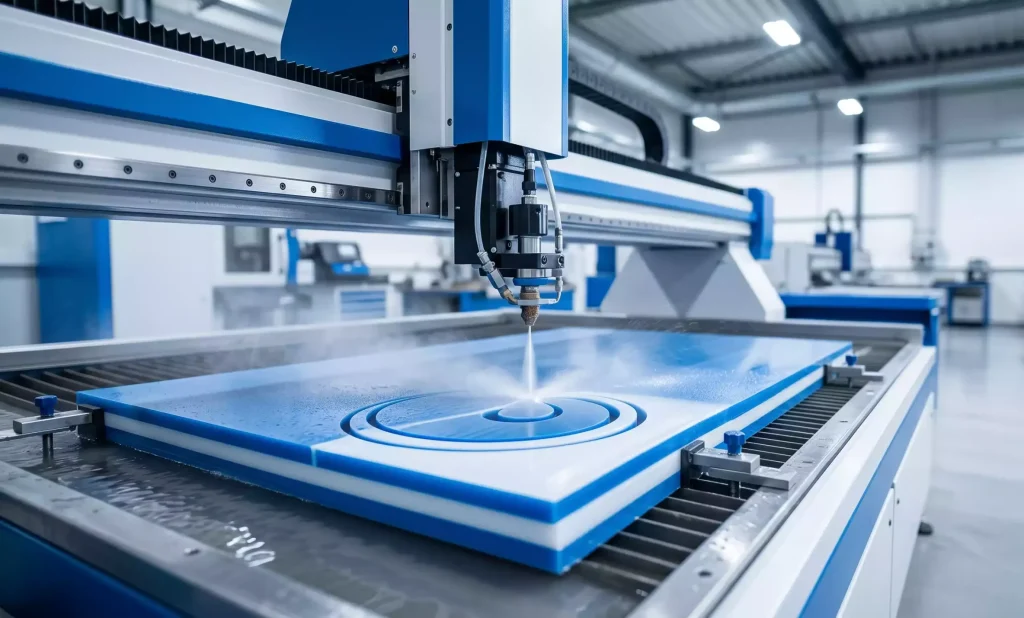
Waterjet cutting has become the gold standard for fabricating thick, high-performance thermoplastic sheets where dimensional accuracy, clean edges, and the complete absence of thermal damage are critical. At Zhi Hong, our advanced abrasive and pure-water waterjet systems transform HDPE sheet, UHMWPE, and polypropylene stock into precision-finished components without melting, burning, or distorting the material. This page explains how cold-cutting technology works, why it outperforms conventional methods for plastics, and how our capabilities serve demanding industries worldwide.

Why Waterjet Cutting Is Ideal for Engineering Plastics
Thermoplastics such as polyethylene and polypropylene have relatively low melting points. Conventional cutting methods—laser, plasma, or high-speed routing—generate localized heat that can soften, melt, re-weld, or warp the workpiece, producing rough edges, internal stress, and dimensional drift. Waterjet cutting eliminates these problems entirely by using an ultra-high-pressure stream of water (up to 60,000 psi), optionally mixed with a fine abrasive garnet, to erode the material in a controlled, room-temperature process.
The result is a burr-free, smooth cut edge that requires little or no secondary finishing, while preserving the full mechanical and chemical properties of the base sheet. For chemically resistant components used in filtration and separation systems, this integrity is essential.
1. Thick HDPE & UHMWPE Cutting

One of the greatest strengths of waterjet technology is its ability to slice through extremely thick plastic stock—often up to 150 mm and beyond—in a single pass. Traditional sawing or routing struggles with thick UHMWPE and HDPE, leaving tapered edges, friction-melted surfaces, or excessive tool wear. Our waterjet systems cut these heavy gauges cleanly and consistently.
This capability is ideal for:
- Heavy-duty wear pads and bearing blocks machined from HDPE PE100 sheets
- Structural marine components produced from Marine Grade HDPE Sheet
- Thick base plates and tank walls cut from HDPE Plate (High Density Polyethylene Plate)
- Liners and chute panels fabricated from HDPE100 Grade Sheet
Because there is no heat transfer, even the thickest sections remain dimensionally stable from top face to bottom face, with parallel, square edges throughout.
2. No Heat-Affected Zone (HAZ) Cold Cutting

The defining advantage of waterjet cutting for plastics is the complete elimination of the heat-affected zone. Because the cutting medium is cold water, the material never reaches its softening or melting temperature. This delivers measurable benefits:
- No melted or re-solidified edges — critical for parts that must seal, weld, or bond cleanly afterward.
- No internal stress or micro-cracking — preserving impact strength and fatigue resistance.
- No toxic fumes — important when processing flame-retardant grades such as Flame Retardant PP Board or PE Flame Retardant Sheet.
- Preserved color integrity — essential for engraved and layered products like Dual Color HDPE Sheet, where clean edges reveal sharp contrasting layers.
This cold-cutting purity makes waterjet the preferred method for food-contact components, hygienic PP Aquaculture Tank Sheet fabrications, and pharmaceutical-grade parts where contamination and material degradation cannot be tolerated.
3. Complex Geometry Profiling

Driven by CNC programming, our waterjet systems follow virtually any 2D profile imported from CAD/DXF files. Intricate contours, sharp internal corners, tight radii, small-diameter holes, and nested production patterns are all achievable with a kerf width as fine as 0.8–1.2 mm. This makes waterjet cutting ideal for prototyping and high-mix, low-volume production alike.
Typical complex-profile applications include:
- Custom gaskets, seals, and flanges from Polypropylene Homopolymer PPH Sheet
- Filtration plates and manifolds from FRPP Sheet
- Reinforced structural brackets from Fiber Reinforced Polypropylene Board
- High-performance technical parts from Polyphthalamide (PPA) Sheet
- Anti-block process components from Polypropylene Anti-Block (PPAB) Sheet
Because the waterjet exerts almost no mechanical force on the workpiece, even delicate or thin features hold their shape without clamping distortion—a key advantage when cutting textured or specialty surfaces such as HDPE Textured Sheet.
Industries We Serve with Waterjet-Cut Plastics

- Chemical Processing & Filtration — corrosion-resistant tank parts, filter plates, and spacers.
- Marine & Offshore — components from HDPE Sheet (High Density Polyethylene) that survive saltwater exposure.
- Material Handling & Mining — wear liners and chute panels.
- Water Treatment & Aquaculture — hygienic tank fittings and baffles.
- Food & Beverage — cutting boards, scrapers, and conveyor parts.
- Construction & Infrastructure — protective panels using PPR Sheets (Polypropylene Random Copolymer Sheet).
Browse our complete PE Sheet Series and PP Sheet Series to select the right base material for your waterjet-cut project.
Material Selection & Custom Tolerances
Choosing the right grade is as important as the cutting process itself. Our engineering team helps you match material properties—density, impact resistance, chemical compatibility, UV stability, and flame retardancy—to your application. For dimensional and weight planning, we provide free online tools below.
Custom Plastic Sheet Weight Calculator
To have more accurate price,
you can use this unit converter to convert the inches unit to mm.
Why Choose Zhi Hong for Waterjet Cutting
- Wide thickness range — from thin gauges to ultra-thick blocks in a single pass.
- Tight tolerances — typically ±0.1–0.2 mm depending on thickness.
- Zero thermal distortion — true cold cutting on every job.
- Custom cut-to-size service — explore our plastic cut-to-size options.
- Full in-house material supply — as an established plastic sheet manufacturer, we control quality from extrusion to finished part.
Learn more about us and our manufacturing capabilities, or read why the benefits of HDPE make it an ideal candidate for precision waterjet fabrication.
Frequently Asked Questions
How thick a plastic sheet can waterjet cut?
Our systems routinely cut HDPE and UHMWPE up to 150 mm thick, with thicker sections possible depending on geometry and tolerance requirements.
Does waterjet cutting leave a rough edge on plastic?
No. Waterjet produces a smooth, satin-finish edge with no burrs or melting. Most parts need no secondary finishing.
Will the water damage or absorb into the plastic?
No. HDPE, UHMWPE, and PP have negligible water absorption. Parts are dried after cutting and retain full performance.
Can you cut complex shapes and small holes?
Yes. CNC-controlled waterjet handles intricate contours, internal cutouts, and holes from CAD/DXF files with high repeatability.
Request a Waterjet Cutting Quote
Send us your drawings, material grade, and quantity. Our team will recommend the optimal sheet and provide a fast, competitive quotation. Contact us today.

