

Metal-on-metal contact is the silent enemy of every conveyor line. Roller chains grind against steel tracks, motors work harder than they should, and noise levels climb. UHMWPE wear strips solve this problem. These ultra-high molecular weight polyethylene components sit between moving metal parts, cutting friction, absorbing shock, and running dry without lubrication. Below, we break down the physics, the profile options, and the installation rules that keep automated lines running quietly for years. Modern packaging and sorting systems now rely on a full range of engineered conveyor wear components to protect chains and reduce downtime.
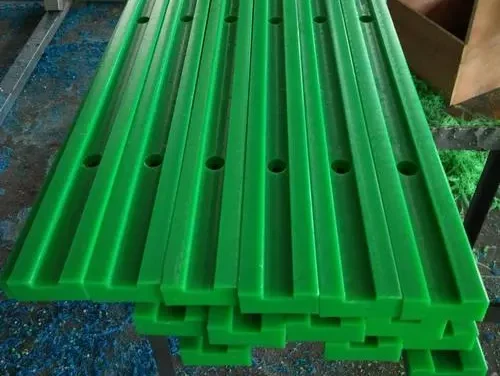
Tribology of UHMWPE: How Ultra-Low Friction Saves Motor Power
Friction is measured by a simple number: the coefficient of friction (μ). UHMWPE scores between 0.10 and 0.15 against steel. That’s close to PTFE, but with far better impact resistance. Compare that to nylon (0.25–0.35) or acetal (0.20–0.25), and the difference adds up fast. Lower friction means less torque draw on drive motors — often a 25% to 40% reduction on long conveyor runs.
There’s a second benefit beyond energy savings. UHMWPE has slight surface give. It absorbs small particles of dust or debris instead of trapping them against the chain. This prevents scuffing and galling, the cold-welding effect that ruins stainless steel rollers over time. The result: chains last longer, and strips protect the metal instead of wearing it down.
Common Cross-Section Profiles: From Flat Strips to Complex Channels
Not every application needs the same shape. Manufacturers typically offer:
- Flat strips(3mm–12mm thick) for belt support and box guiding
- C-channels and U-profilesthat clip onto sheet-metal edges without screws
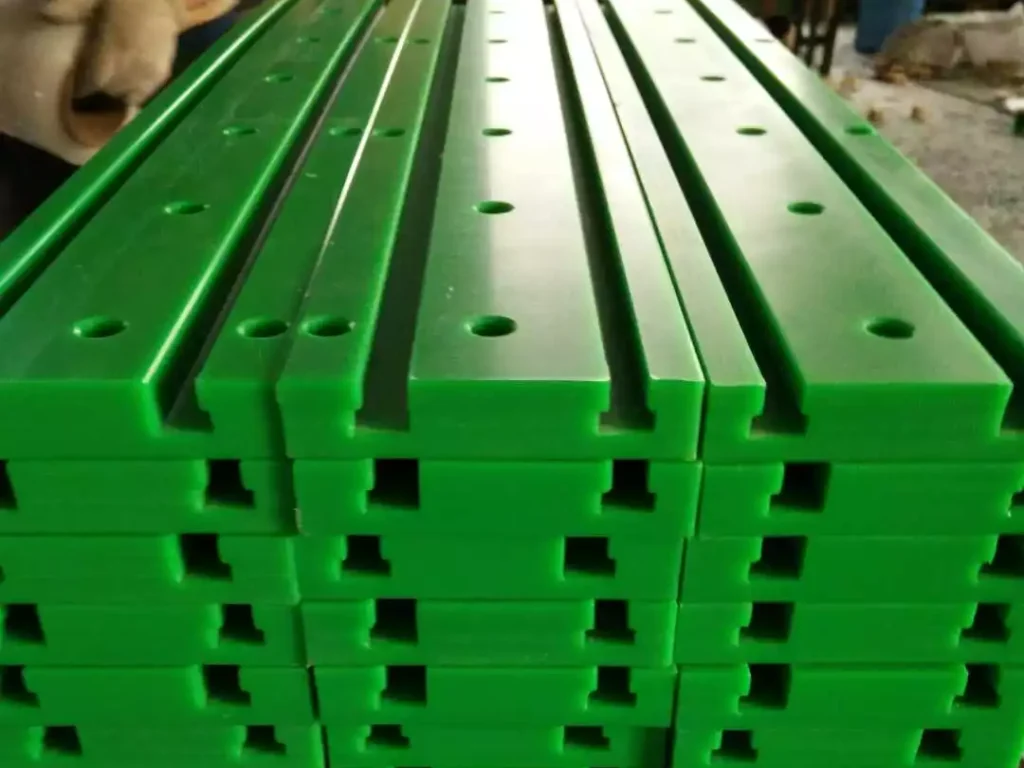
- Chain guide profilesmachined to DIN 8187 or ANSI standards, with grooves cut for single or double-row roller chains
Entry points matter just as much as the main profile. A 30-degree lead-in chamfer at the strip’s edge keeps packages from catching or tipping at transition points. Because these details vary by production line, most buyers work with a supplier offering custom edge profiling services to match exact CAD drawings rather than settling for stock shapes.
Machined vs Extruded Profiles: Molecular Weight Integrity
How a wear strip is made affects how long it lasts.
Machined from pressed sheet: Large UHMWPE blocks, pressed from resin in the 5–9 million molecular weight range, are sawn and milled into strips. Because the molecular chains aren’t exposed to high shear, wear resistance stays near its theoretical maximum.
Ram extrusion: This method produces long, seamless lengths — useful for a single six-meter rail or a continuous coil. The tradeoff is heat during extrusion, which can lower effective molecular weight to roughly 3–4 million.
For abrasive environments like mining conveyors or food-grade packaging lines, the choice of resin grade matters more than most buyers expect. Reviewing a supplier’s full line of industrial plastic sheet materials before specifying a grade helps avoid premature wear failures.
Thermal Expansion, Fastening Methods & Weight Calculator Integration
Plastic expands and contracts far more than steel. UHMWPE’s thermal expansion rate is roughly ten times that of carbon steel. Ignore this, and strips will buckle or crack around fixed screws.
The fix is simple: never bolt a long strip through tight, fixed holes. Instead:
- Cut slotted (oblong) mounting holes along the strip’s length
- Use countersunk screws recessed 2–3mm below the sliding surface
- Or slide the strip into a steel C-channel track, anchoring only one end while the other end floats freely
Getting quantities right matters too, especially for large installations spanning hundreds of meters. Two tools speed this up considerably:
- An inch-to-millimeter converter for reconciling imperial conveyor drawings with metric stock sizes: =
- A weight and length calculator using UHMWPE’s density (0.93–0.94 g/cm³) to estimate total tonnage for bulk orders:
Procurement teams sizing a full conveyor retrofit can run these numbers directly through the plastic sheet weight calculator before placing a bulk order.
UHMWPE vs HDPE vs Oil-Filled Cast Nylon
Not every application justifies premium UHMWPE. For light-duty, lower-speed guides where budget is the priority, precision-finished durable engineering plastic plates in HDPE can perform well at a lower cost. But for heavy loads, high speeds, or abrasive dust, UHMWPE remains the only reliable choice. Cast nylon falls in between — good load capacity, but higher moisture absorption and a tendency to squeal under dry friction.
Frequently Asked Questions
1. Why choose UHMWPE over PTFE or nylon for conveyor wear strips?
PTFE has excellent friction properties but poor compressive strength and a tendency to cold-flow under load. Nylon absorbs moisture and often squeaks under dry friction. UHMWPE combines PTFE-like low friction with zero water absorption and far better wear resistance than either alternative.
2. How do you stop UHMWPE strips from buckling with temperature changes?
Never lock a long strip down with fixed screws. Use slotted mounting holes so the material can expand and contract freely, or mount it inside a steel C-channel with only one fixed anchor point and 5–10mm of expansion clearance at the other end.
3. Can UHMWPE wear strips be used on food or pharmaceutical lines?
Yes. Virgin natural UHMWPE meets FDA 21 CFR 177.1520 and EU 10/2011 standards. Metal-detectable grades are also available for lines requiring X-ray or metal-detector compliance.
4. How deep should screw heads be countersunk?
At least 2.5–3.0mm below the sliding surface. This keeps the surface smooth for product flow and leaves years of wear margin before the strip surface reaches the screw head.
5. How much shorter is the wear life of recycled UHMWPE vs virgin material?
Reprocessed black or green strips typically last 75–80% as long as virgin white UHMWPE, due to slightly lower molecular weight. They cost less and resist UV better, making them a good fit for general logistics and non-food applications.
Reliable, quiet conveyor performance starts with the right resin grade and precise profile tolerances. Send your cross-section drawings for a custom quote, or order standard strip lengths and sheet stock directly from stock.



