

Zhihong Plastics ground protection mats 4×8 provide unsurpassed durability and performance for construction projects and heavy machine operations. Heavy-duty ground protection mats 4×8 are made of high-quality materials to sustain heavy loads and prevent costly ground damage on construction sites, vehicle access roads, and equipment staging areas. Understanding load capacity, material composition, and protective benefits of 4×8 ground protection mats wholesale or suppliers helps you choose the best product for your project.
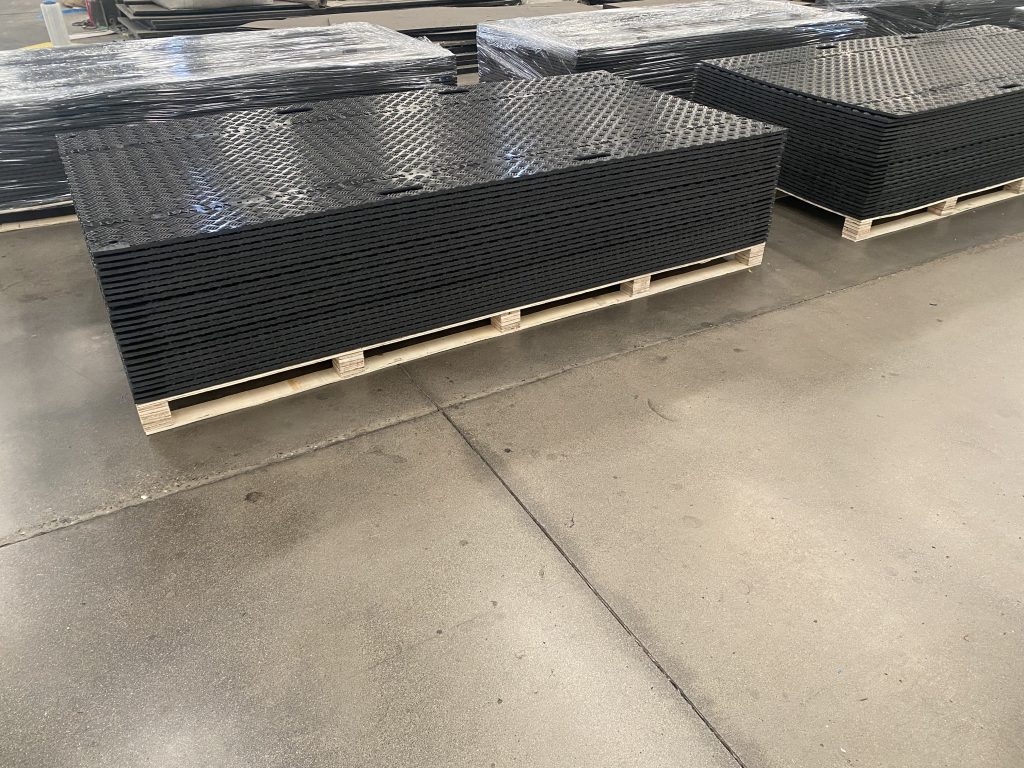
Material and Construction
Advanced engineering and quality material selection underpin reliable ground protection mats 4×8. Most of these mats are made from HDPE, a thermoplastic with a high strength-to-weight ratio and chemical resistance. Additionally, engineers use reinforced polymer blends to increase structural longevity and load-bearing capacity. A matrix of polymer combinations distributes weight uniformly over the mat surface. Special UV-resistant chemicals prevent solar deterioration and increase material life. Weatherproofing ensures performance in cold and tropical temperatures and humidity. Ground protection mats 4×8 made of these materials are durable.
Modern production ensures consistently high-quality 4×8 ground protection mats. Production relies on injection molding to manage material distribution and surface texturing. This procedure uniformly thickens mats and eliminates structural weaknesses. Quality control for ground protection mats 4×8 manufacturers includes rigorous load capacity, flexibility, and dimensional accuracy testing. Stress testing ensures each mat satisfies weight restrictions before leaving the facility. Final checks verify interlocking mechanisms and surface treatments satisfy industry standards. Comprehensive production standards produce reliable products that function well in demanding construction and industrial environments.
Load and Performance
Professional ground protection mats 4×8 offer high load-bearing characteristics for industrial use. Depending on material composition and thickness, these mats may distribute 80–120 tons. Construction sites need higher load-bearing capacities than pedestrian walkways or light vehicle access. Safety factors also include thorough testing to certify structural integrity under maximum load. Tests analyze point loads and dispersed weight scenarios to determine reliability. Industry guidelines also require manufacturers to exceed minimum load ratings by large percentages to provide operational safety buffers for unanticipated weight concentrations.
Heavy equipment operators wonder if ground protection mats 4×8 are suitable for their demanding applications. The answer depends on equipment requirements. These mats work well with 80-ton excavators, mobile cranes, and bulldozers on prepared surfaces. Heavy equipment ground protection mats 4×8 have stronger interlocking mechanisms and thicker profiles. Under dynamic stresses, the mats absorb and distribute energy from moving equipment. Extended equipment staging without mat degradation is easier with static loads. Thus, project managers prefer these protective solutions for temporary roadways, equipment staging areas, and sensitive ground protection in various construction conditions.
Uses and Benefits
Professional contractors often ask about 4×8 ground protection mats’ benefits. These mats avoid irreparable harm to delicate ecosystems and manicured areas. Increased equipment mobility lets heavy machinery travel previously inaccessible terrain without rutting or harming underground infrastructure. Construction teams appreciate lower site restoration costs because they avoid costly soil replacement and re-seeding. By providing firm working surfaces throughout the project, ground protection mats 4×8 also eliminate liability worries. Environmental compliance inspectors like these solutions because they reduce environmental effect and promote sustainable development.
Ground protection mats 4×8 are mostly used on construction sites as temporary highways for excavators and concrete trucks on difficult terrain. Ground protection mats 4×8 for vehicles offer solid access roads over marshes, agricultural fields, and sensitive environments. Event managers use these mats to protect lawns and prevent mud at outdoor festivals and temporary constructions. Because the mats use superior weight distribution mechanics to spread concentrated loads across larger surface areas, the preventative methods are sophisticated. Because the stiff surface prevents equipment from pressing directly on soil structures, soil compaction is prevented. The resilient polyethylene design absorbs repetitive impacts that would permanently deform the surface.
Setting Up and Maintaining
Ground protection mats 4×8 must be installed strategically to enhance their protective qualities and operating lifespan. Leveling the ground and eliminating sharp debris that could damage mat undersides begins site preparation. Teams place the first mat at the entry site and align subsequent mats using the inherent interlocking mechanisms. Proper alignment prevents equipment from catching edges and ensures smooth unit transitions. Overlapping installation patterns also better distribute loads over mat surfaces. Crews must also ensure that each ground protection mat 4×8 rests flush against adjacent units to avoid structural gaps. Traffic trends and load directions help installation crews choose mat orientation.
Ground protection mats 4×8 are maintained to last longer and work consistently. Dirt, muck, and corrosives can deteriorate polyethylene, thus regular washing removes them. Pressure washing with industrial equipment eliminates tough pollutants without destroying the mat. Stack carpets on level surfaces away from direct sunlight and extreme temperature variations for safe storage. Depending on load frequency and climatic circumstances, standard construction use lifespans are five to 10 years. Regular six-month maintenance examinations reveal stress spots, surface wear, and interlocking mechanism integrity. Teams replace damaged components immediately to ensure safety and system efficacy throughout the project.
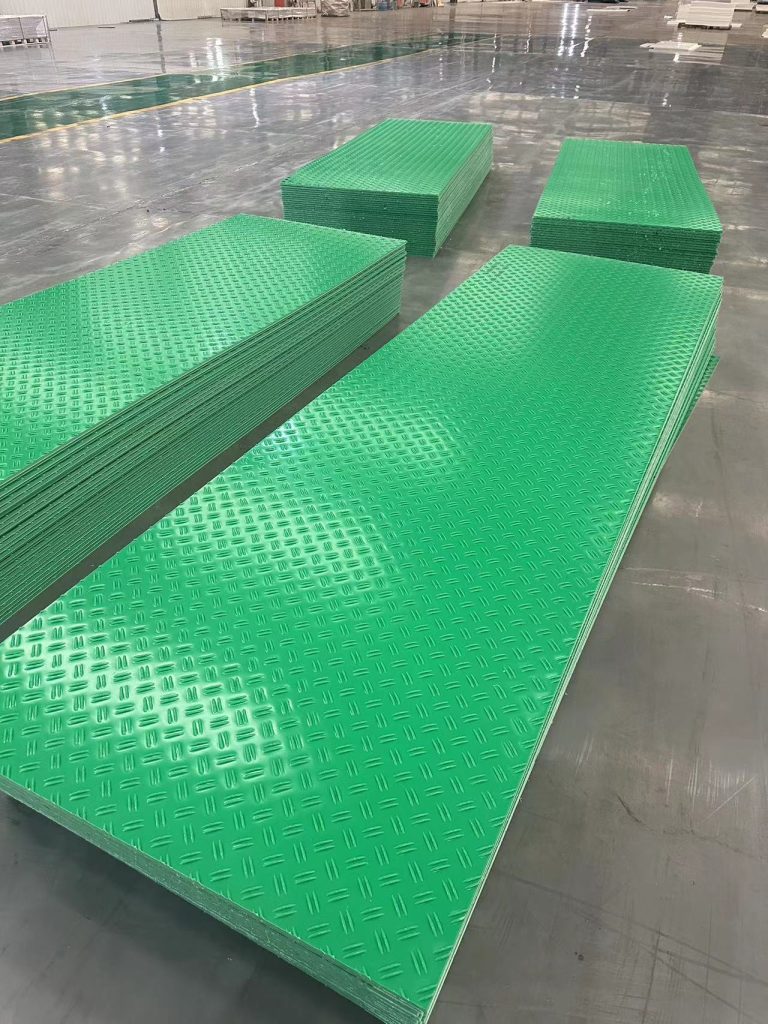
Zhihong Plastics manufactures durable, versatile 4×8 ground protection mats for demanding applications. In construction, industrial, and event settings, our mats support heavy loads, protect sensitive grounds, and improve efficiency. We guarantee project reliability and durability with our high load-bearing capacity and durable materials. Safety and efficiency are our top priorities for temporary roadways, equipment staging, and eco-sensitive areas. Zhihong Plastics makes durable, innovative mats for your needs. Explore our products and learn how we can help your next project on our website.
Common Ground Protection Mat Materials
HDPE and composite plastics are the main materials for wholesale ground protection mats. Durable and crack-resistant HDPE is ideal for heavy-duty applications. For large projects, its lightweight design makes transportation and installation easier. Composite polymers are stronger and more flexible, so they can withstand tremendous loads without deforming. Long-lasting performance is guaranteed by both materials’ chemical, moisture, and UV resistance. For reliable and durable wholesale ground mats for construction and temporary roadways, these properties are excellent.
These materials also equally distribute weight. HDPE and composite mats surface temporary roadways with a non-slip surface. They are cost-effective bulk ground protection mats due to their reusability. These materials function well in harsh settings, therefore businesses seeking affordable ground protection mats wholesale generally choose them. HDPE or composite matting help firms operate projects effectively while reducing environmental impact and maintenance costs.
Buying Bulk: Quality Control
Quality wholesale ground mats for heavy equipment are important for safety and performance in demanding situations. To ensure mat durability and load-bearing capacity, buyers should test them thoroughly. Mats are tested for cracking. Long-term use can also be confirmed by checking material composition, such as HDPE or composite plastics. Stability and traction during operations depend on thickness and surface texture consistency. These evaluations ensure the mats withstand heavy equipment use.
Certifications and supplier reputation are important to product quality. Buyers should prioritize ground protection mats suppliers with industry-recognized certifications. Reputable ground protection mats distributors provide product specs and testing results for transparency and confidence. Suppliers who are reliable and satisfy customers are more likely to deliver high-quality products. Businesses can find wholesale ground protection mats that satisfy their operational objectives while minimizing hazards and assuring long-term value by concentrating on these factors.
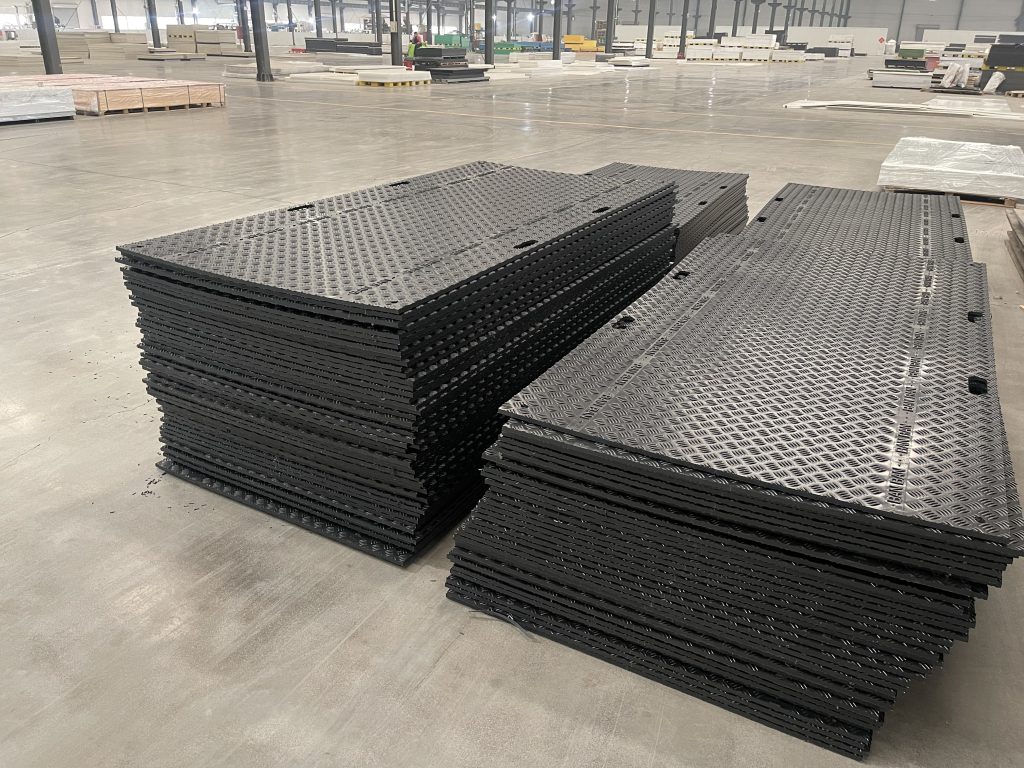
We offer high-quality ground protection mats at wholesale prices at Zhihong Plastics. For construction, oil and gas, and environmental projects, our HDPE and composite materials can withstand heavy loads and harsh conditions. We provide cost-effective bulk solutions with customization options to meet your operational needs. We manufacture durable mats that protect ground integrity and support heavy equipment for over a decade. Zhihong Plastics offers durable, affordable, and effective wholesale ground protection solutions. Visit our website to browse our extensive selection and ensure project success.
Why HDPE Became the Standard Material
High-density polyethylene took over this category for good reasons. It is tough, light for its strength, and shrugs off water, mud, fuel spills, road salt, and most site chemicals. Wood mats absorb moisture, rot, and grow heavier every season. Steel plates work but are punishing to move and become skating rinks when wet.
HDPE mats sit between the two. A standard 4×8 mat weighs roughly 85 to 115 pounds depending on thickness, so two workers can carry and set one without machinery. They stay dimensionally stable from about -40°F up to 180°F. They do not splinter, absorb odors, or harbor bacteria.
For heavier duty work, ultra-high molecular weight polyethylene (UHMW) adds abrasion resistance that outperforms carbon steel in sliding wear tests. Most contractors do not need it, but for tracked machinery on rocky ground it earns its cost.
Our HDPE ground protection mats use virgin and high-grade recycled resin blends with UV stabilizers compounded into the melt, not sprayed on the surface. That distinction matters more than most buyers realize.
Load Ratings and What They Really Mean
Sellers quote numbers like “120 tons” or “80 PSI ground pressure.” These figures assume ideal soil conditions and even load distribution. Real sites are messier.
A better way to think about it: the mat spreads a concentrated point load across a wider footprint. A 60,000-pound excavator on bare soil might exert 12 PSI through its tracks. Place mats underneath and that same load spreads across 32 square feet per mat, dropping effective ground pressure substantially.
Thickness drives capacity. Common options:
- 12mm to 15mm— foot traffic, light utility vehicles, event flooring, turf protection
- 20mm to 25mm— pickup trucks, skid steers, small lifts, most general contracting
- 30mm to 40mm— excavators, cranes, drill rigs, loaded concrete trucks
- 50mm and above— heavy crane matting, pipeline access, sustained tracked traffic
If you are buying ground protection mats for heavy equipment, do not undersize. A mat that flexes past its limit develops stress whitening and eventually splits along the bend line. Going one thickness grade up costs maybe 20% more and can double service life.
Soil condition changes everything too. On firm compacted gravel, a 20mm mat handles more than the same mat on saturated peat. Ask your supplier about your specific ground type before ordering.
Sizes, Handles, and Connection Systems
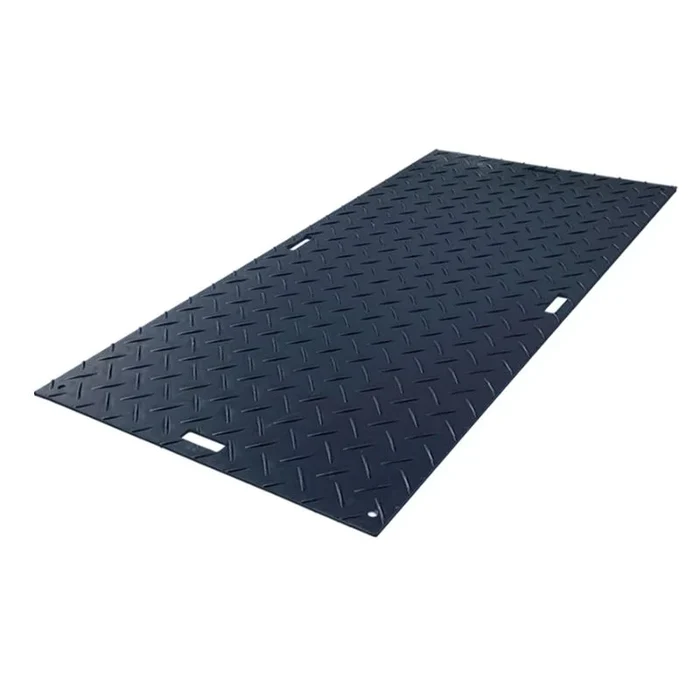
The 4×8 foot panel (roughly 1220 x 2440mm) dominates the market because it fits standard transport and matches plywood dimensions crews already know. You will also find 3×8, 4×10, and metric 1m x 2m or 1.5m x 3m formats.
Handle design deserves attention. Cut-out hand holes are simplest and cheapest, but they create stress points if placed badly. Recessed grip pockets hold up better. For larger mats, look for lifting eyes or rope holes rated for equipment handling.
Connection hardware turns individual mats into continuous roadway. Common systems include:
- Steel or nylon turnbuckle connectors
- Overlapping lip joints molded into the panel edge
- Bolt-through pin systems for permanent installations
- Rope or cam-lock ties for quick temporary layouts
Connected mats resist separation under turning loads. Loose mats shift, gap open, and let equipment drop between panels. If your application involves repeated vehicle traffic, budget for connectors.
For panel sizes, thicknesses and load ratings across the range, see our ground protection mats 4×8 supplier page.



