

Heavy machines sink. Lawns tear. Access roads turn to soup after two days of rain. HDPE mats solve that problem with a simple idea — spread the weight of a machine across a wide, stiff plastic panel so the ground underneath stays intact. An HDPE mat is a thick panel cut from high density polyethylene sheet stock. Most mats measure 4 ft × 8 ft, though 3 ft × 8 ft and 2 m × 1 m sizes are common in Asia and Europe. Thickness usually runs from 12 mm to 25 mm. Weight lands between 30 kg and 60 kg per panel, so two workers can lift and place one without a crane.
What Makes High Density Polyethylene a Good Mat Material
High density polyethylene, or HDPE, is a thermoplastic with a density near 0.95 g/cm³. The polymer chains pack tightly and line up in an orderly way. That tight packing gives the material its stiffness, its low water absorption, and its resistance to acids, salts, alkalis, and most fuels.
A few numbers matter to anyone specifying mats:
|
Property |
Typical value for HDPE |
|
Density |
0.94 – 0.96 g/cm³ |
|
Tensile strength |
22 – 31 MPa |
|
Notched impact strength |
No break at 23 °C |
|
Water absorption |
Below 0.01 % |
|
Service temperature |
−60 °C to +80 °C |
|
Coefficient of friction |
0.20 – 0.25 (dry, against steel) |
Water absorption below 0.01 % is the figure that decides most purchases. A plywood mat drinks water, swells, delaminates, and rots. An HDPE panel does not. Leave it in a flooded trench for a month and pull it out at the same thickness and the same weight.
Low temperature toughness also matters. Many plastics turn brittle in winter. HDPE stays impact resistant well below freezing, so a mat dropped from a flatbed at −20 °C does not crack.
How Sheets Turn Into Mats
Production starts with virgin or recycled HDPE resin, sometimes blended with carbon black for UV protection. The resin melts in an extruder at roughly 190 °C to 230 °C. A flat die spreads the melt into a wide ribbon. A three-roll calender stack then presses the ribbon to the target thickness and cools it under controlled pressure.
Thickness tolerance out of a well-run line stays within ±0.3 mm on a 20 mm panel. That consistency is what keeps a mat from rocking when it sits on flat ground.
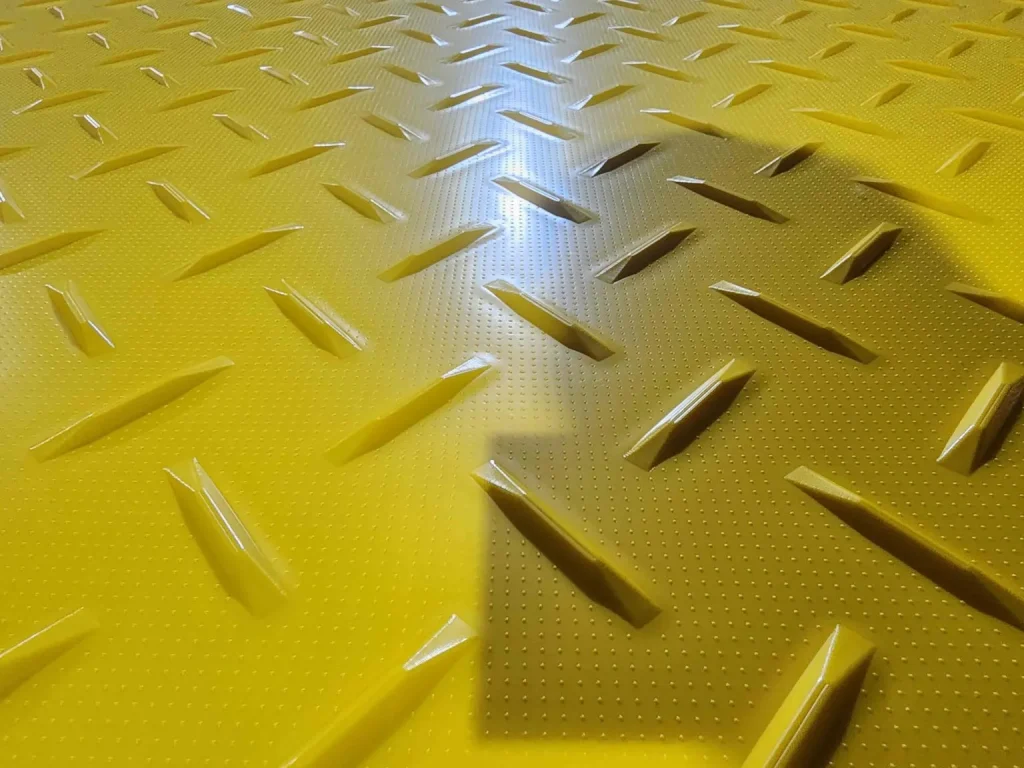
The sheet then moves to cutting, edge trimming, and hole drilling. Most mats get 4 to 12 hand holes so crews can lift, drag, or hook them with a chain. Some designs add a diamond or hammered pattern on both faces during calendering, which raises traction for tires and boots. Zhihong produces both plain and patterned versions, including a dedicated HDPE anti-slip road mat built for temporary haul routes.
Where HDPE Mats Get Used
Utility and powerline work. Bucket trucks and digger derricks cross private lawns to reach poles and pad-mounted transformers. Mats keep the tires off the turf and keep the homeowner calm.
Pipeline right-of-way. Sidebooms and welding rigs travel the same path dozens of times. A mat road spreads that traffic and cuts down on rutting and restoration cost.
Crane and lift pads. Panels stacked two or three deep under outrigger plates spread the point load over soft fill.
Event flooring. Concerts, marathons, and county fairs put trucks and forklifts on grass fields. Mats go down before the crowd arrives and come up without turf damage.
Drilling and solar sites. Mud mats build access lanes across marsh, sand, and farm soil.
Wind farm access. Long panel runs support blade trailers on soft shoulders.
For heavier equipment — excavators above 30 tons, cranes, and loaded concrete trucks — buyers usually step up to 25 mm panels or double-layer mats. Zhihong’s ground mats for heavy equipment page covers those load ranges in more detail.
Thickness and Load Guidance
A rough field guide many contractors follow:
- 12 mm— pedestrian walkways, pickups, small skid steers, event grass protection
- 16 mm— mini excavators, bucket trucks, light utility rigs
- 20 mm— standard access roads, 20-ton excavators, forklifts with loads
- 25 mm and up— cranes, drill rigs, heavy haul, outrigger pads
Ground conditions change the answer. Soft peat needs more thickness or a second layer than compacted gravel does. When in doubt, test one panel under the actual machine before ordering a full load.
High Density Polyethylene Uses Beyond Ground Protection
The same material shows up across a surprising range of industries, which explains why HDPE is one of the most produced plastics on earth.
Chemical tanks and liners. HDPE resists sodium hydroxide, sulfuric acid, brine, and most solvents. Fabricators weld sheets into tanks, scrubber bodies, and secondary containment.
Cutting boards and food handling. The surface is non-porous and easy to sanitize. FDA-grade sheet becomes cutting boards, conveyor guides, and processing tables.
Marine and dock components. Fender pads, dock bumpers, boat seat bases, and hatch covers. Marine grade sheet carries UV additives and a textured face.
Rink and arena boards. Arena dasher facings, puck boards, and shielding.
Wear parts. Chain guides, star wheels, bearing pads, and liner strips in bulk handling.
Water and gas piping. PE100 grade resin makes pressure pipe rated for 50-year service.
Landfill geomembrane. Thin HDPE liner sheets seal cells and prevent leachate migration.
Buyers often ask which grade to pick. Standard HDPE handles most jobs. PE100 grade offers higher tensile strength and better slow crack growth resistance. UHMWPE — ultra-high molecular weight polyethylene — costs more and delivers far better abrasion resistance for chutes and liners. Zhihong stocks all three families, with sizing and weight math handled through its plastic sheet weight calculator.
HDPE Mats Compared With Plywood and Steel
Plywood costs less on day one. It also absorbs water, splinters, delaminates, and often lasts a single season. Crews replace it constantly and pay disposal fees each time.
Steel mats carry enormous loads but weigh several hundred kilograms each. They need machinery to place, they rust, and they conduct electricity — a real concern near energized lines.
HDPE lands in the middle. A 20 mm panel weighs about 40 kg. It floats, so flood water does not bury it. It does not conduct, which utility safety officers appreciate. Service life runs five to ten years with normal handling. Panels stack flat on a trailer and clean off with a pressure washer.
Cost per use is where HDPE wins. A mat that survives forty deployments beats plywood that survives three, even at four times the purchase price.
Care Notes That Extend Service Life
Wash mud off before stacking. Dried clay adds weight and hides cracks. Store panels flat, not leaning against a wall, since long-term bending sets a permanent bow. Keep them out of direct sun in storage yards if the resin lacks UV additives — black panels with carbon black hold up far longer outdoors than natural white ones.
Drag mats with the grain of the hand holes, not sideways. Sideways pulls tear hole edges over time. If a hole does tear, drill a fresh one 100 mm away rather than scrapping the panel.
Questions Buyers Ask Most Often
1. Can HDPE mats be repaired?
Yes. Cracks can be extrusion welded with HDPE rod at around 200 °C. The repair holds well if the surface is clean and dry.
2. Do they get slippery?
Smooth panels do when wet or muddy. Textured or diamond-pattern faces raise grip noticeably. Most buyers choose textured for wheeled traffic.
3. What colors are available?
Black is standard and most UV stable. Green, white, and safety orange are common. Two-color sheets with a contrasting core help mark wear depth.
4. Are recycled panels worth it?
Recycled HDPE costs less and works fine for pedestrian paths and light traffic. For crane pads and heavy haul, virgin or high-quality regrind delivers more predictable strength.
5. Minimum order?
Most Chinese manufacturers ship by the container. A 20 ft container holds roughly 130 to 160 panels at 20 mm, depending on size.
Why You Need The HDPE Anti-Slip Road Mat
First, let us look at the base material itself. High-density polyethylene is an extremely tough and rigid plastic. Therefore, an HDPE anti-slip road mat can support heavy weights very easily. In fact, these mats resist water, harsh chemicals, and extreme weather completely. Also, the special textured surface adds significant grip for tires and boots. As a result, trucks and pedestrians will not slip on wet rainy days. Furthermore, workers can carry these mats by hand across the site. Because of this lightweight design, you do not need heavy cranes for the setup process. Meanwhile, they outlast traditional wooden planks by many long years. Thus, you get a much better return on your initial investment. For more details on the strong base material, you can explore our standard HDPE sheet options.
Heavy Construction Site Ground Protection
Construction projects always face highly unpredictable weather conditions. Usually, heavy rain turns solid dirt into thick dangerous mud. Because of this, expensive dump trucks often get stuck for hours. However, an HDPE anti-slip road mat creates an instant stable road quickly. As a result, your vehicles can move freely and safely across the entire site. Furthermore, the mats distribute the heavy vehicle weight evenly over the soft ground. Thus, you prevent deep muddy ruts and very costly landscape damage. In addition, these mats protect sensitive underground pipes from crushing heavy pressure. Therefore, smart site managers always stack these mats near the entrance. You can learn about the extreme durability of this plastic by checking out our HDPE PE100 sheets.
Safe Walkways For Outdoor Festivals
Music festivals often take place on beautiful grassy green fields. Naturally, thousands of people walking around will destroy the soft grass very quickly. Also, sudden rain can turn the festival area into a dangerous muddy mess. However, smart event planners use an HDPE anti-slip road mat to solve this common problem. First, the mats protect the delicate grass underneath from heavy foot traffic. Furthermore, the textured surface prevents happy visitors from slipping and falling down. Therefore, you keep your valuable guests safe and completely clean. In addition, food vendors can easily roll their heavy supply carts over the smooth flat paths. If you need special materials for wet environments, consider our marine grade HDPE sheet for other similar projects.
Thickness, Size and Weight Numbers
Most heavy duty driveway mats ship in a 4 ft x 8 ft panel because it fits standard truck beds and standard pallets. Custom lengths up to 3 x 10 metres are available from extrusion lines built for wide sheet.
|
Thickness |
Typical use |
Approx. weight (4×8 panel) |
|
1/2 in (12.7 mm) |
Pickups, pedestrian walkways, event flooring |
79 lb / 36 kg |
|
5/8 in (16 mm) |
Light trucks, skid steers, scissor lifts |
99 lb / 45 kg |
|
3/4 in (19 mm) |
Concrete trucks, boom lifts, mid-size excavators |
118 lb / 54 kg |
|
1 in (25.4 mm) |
Cranes, drill rigs, loaded lowboys |
157 lb / 71 kg |
Two workers handle anything up to 3/4 inch without lifting gear. Above that, a strap and two people, or a machine with a hook.
Buyers sometimes ask why a thicker panel does not always mean better performance. Above roughly one inch, stiffness starts working against you on soft ground. The panel bridges hollows instead of settling into them, and the load concentrates on the high spots. Match the thickness to the machine and the soil, not to a spec sheet number.
Surface Texture and Grip
A smooth polyethylene panel in the rain is a hazard. Any serious mat has a molded or embossed pattern on both faces.
Diamond tread and directional cleat patterns give tires something to bite. Fine sand-grain texture works better for foot traffic and for tracked machines, since it grips without catching rubber pads. Two-sided texture doubles service life, because crews flip the panel once one face polishes down.
Cleat depth is worth checking before you buy. Shallow stamping wears flat within a season on gravel. A deeper molded cleat, roughly 1.5 to 3 mm, holds traction far longer. Panels like this HDPE anti-slip road mat are pressed with a pattern deep enough to stay useful after repeated hauling and washing.
How To Choose the Right Panel
Start with the heaviest machine that will cross. Get its axle or track load, not its total weight. Then look at the ground. Firm gravel forgives a thin panel. Wet clay does not.
Ask the supplier three questions. What resin grade and what melt index? Is the material virgin, or blended with regrind, and in what ratio? What is the tested notched impact strength at low temperature?
Virgin PE100 grade material gives the best stiffness-to-weight balance. A blend with clean regrind cuts cost and still performs on general access work. Dirty regrind cracks at the bolt holes in cold weather, and no price is low enough to make that worthwhile.
Finally, confirm the panel dimensions against your transport. Fifty 4×8 mats fill a 20 ft container comfortably. Odd sizes waste space and freight is rarely cheap. For crews sourcing ground protection mats for heavy equipment in volume, that shipping math often decides the final cost per square foot.
Heavy machine HDPE ground protection mats: how durable?
HDPE ground protection mats are built to last in construction and industry. These mats are ideal for cranes and trucks because they disperse enormous loads and withstand high-impact stress. They perform reliably without sinking or warping on uneven terrain due to their robustness. Their resilience to chemicals, UV radiation, and severe temperatures extends their use in various situations. HDPE ground protection mats are used in heavy-duty applications because they stabilize machinery and preserve beneath surfaces.
-
What to consider when buying HDPE ground protection mats?
Choose the correct HDPE ground protection mat by considering size, weight, and thickness for your project. For heavy machinery safety and performance, mats with the right thickness and load capability are best. The HDPE ground protection mat dimensions should match the terrain type for seamless coverage of uneven or soft ground. To reduce movement and maintain stability, consider layout design during installation. Lightweight solutions are durable and easy to travel and install. HDPE ground protection mat weight, thickness, and installation techniques all affect surface protection.
Why High Density Polyethylene Suits Outdoor Work
There are other materials on the market. Plywood, steel plate, and aluminium track all have their fans. Yet HDPE mats keep gaining ground, and the reasons are easy to list.
Water does nothing to them. HDPE absorbs almost no moisture. A mat left in standing water for a month weighs the same as the day it arrived. Plywood swells, delaminates, and rots.
They resist chemicals. Diesel, hydraulic oil, brine, fertiliser, and most acids leave no mark. This matters on refinery grounds, farms, and utility corridors.
They handle cold. Good mats stay usable well below freezing. Cheap recycled panels turn brittle and crack when a loader tracks across them at minus twenty.
UV protection is built in. Carbon black and stabiliser packages keep the surface from chalking after seasons in direct sun.
They are light enough to move by hand. Two workers can carry a standard panel. Compare that with a steel road plate that needs a machine and a sling.
They can be reused for years. A well made mat survives hundreds of placements. The cost per use drops to almost nothing.
That combination explains why so many contractors now stock HDPE ground protection mat panels as standard equipment rather than renting timber every time.
How to Match a Mat to the Load
Start with the heaviest single axle that will cross the mat, not the total machine weight. A 30 tonne excavator spreads load through wide tracks. A 12 tonne service truck concentrates load on four small contact patches. The truck often needs a thicker mat.
Next, look at the ground. Firm gravel supports the panel across its whole face, so a thinner mat works. Soft peat or fresh fill offers almost no support, and the panel must carry the load on its own stiffness. Move up two thickness steps for very soft ground.
Then count the passes. A one-time crane lift is different from a haul road that sees two hundred trips a week. High traffic calls for thicker panels and mechanical connectors between them.
Finally, think about temperature. If your site drops well below freezing, ask for a low temperature impact grade.
What to Ask a Supplier
- Is the panel made from virgin resin, recycled material, or a blend?
- What is the tested density and tensile strength?
- Is UV stabiliser included, and at what level?
- Are both faces textured?
- What load rating applies, and on what ground type?
- Which connector system is supplied?
- What thickness tolerance is guaranteed?
- How many panels fit in a 20 ft and 40 ft container?
Clear answers signal a real manufacturer. Vague answers usually mean a trading company that has never run an extruder.
Hebei Zhihong Plastic Products Manufacturing Co., Ltd. has produced extruded HDPE, PP, and UPE panels since 2012 from our plant in Wuqiao County, Cangzhou. We supply mats and sheets across more than twenty provinces in China and into Southeast Asia, in custom sizes, colours, and thicknesses. Send your load figures and site conditions, and we will recommend a specification that fits the job.
Why Ground Pressure Matters More Than Total Weight
Most people focus on how much a machine weighs. The number that actually damages soil is ground pressure — weight divided by contact area.
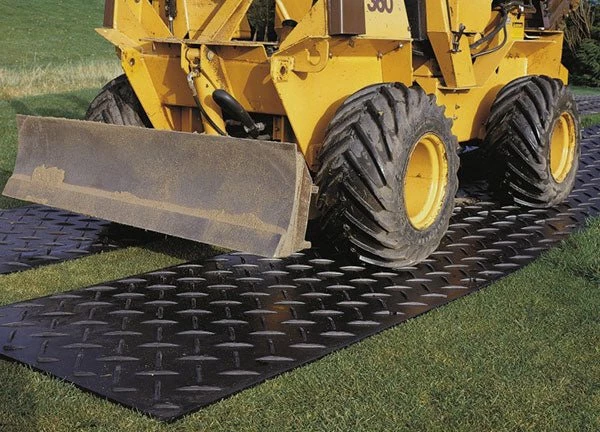
A rubber-tired backhoe might weigh less than a tracked dozer, yet it can cause far more rutting. The tires touch a small patch of earth. All that mass pushes down through four contact points. Wet clay has no chance.
An HDPE mat changes the math. A 4×8 panel gives you 32 square feet of bearing surface. The same load now presses on far more area, so pressure per square inch drops sharply. Soil compaction goes down. Rut depth goes down. Restoration cost goes down with it.
This is why HDPE ground protection mats have replaced timber cribbing and plywood on so many sites. Wood works, briefly. Then it soaks up water, splits along the grain, and turns into disposal cost.
Material Choices and What They Mean on Site
Not every plastic mat performs the same. The polymer grade sets the ceiling on what the panel can handle.
High density polyethylene (HDPE) is the workhorse. It resists moisture completely, shrugs off diesel and hydraulic fluid, and stays flexible in cold weather. HDPE will not rot, will not splinter, and will not absorb contaminants from the site. Panels made from virgin or high-quality regrind material hold up through hundreds of cycles.
Ultra high molecular weight polyethylene (UHMW) goes further on abrasion resistance. It costs more. For most access road work, HDPE handles the job at a better price point.
Polypropylene has its uses in construction plastics, but it turns brittle in freezing conditions. For mats that see winter service, HDPE is the safer specification.
Thickness matters as much as the polymer. A half-inch panel suits foot traffic, pipe laying, and light utility vehicles. Machines in the 20-ton range need 3/4 inch or thicker. Anything above that — cranes, drill rigs, loaded articulated trucks — calls for one-inch panels and sometimes a double-layered approach.
Specification Details Worth Confirming
Ask suppliers direct questions before you commit to an order.
Material source. Virgin resin, controlled regrind, or mixed recycled scrap? Mixed scrap panels vary in strength and can delaminate.
UV stabilization. Panels live outdoors. Carbon black or a UV additive package prevents surface chalking and brittleness after long sun exposure.
Load rating. Get a documented figure, not a vague claim. Match it to your heaviest machine.
Temperature range. Cold-weather impact resistance separates good HDPE from marginal material.
Tolerance on thickness. Uneven panels flex unpredictably and wear faster in the thin spots.
Cut-to-size capability. Odd site geometry sometimes needs custom dimensions. A manufacturer with in-house extrusion can accommodate that.
At Hebei Zhihong, our extrusion lines produce sheets from 2mm up to 100mm thick, in widths that suit standard and custom mat formats. Full details on our HDPE ground protection mats cover available thicknesses, textures, and load specifications.
Frequently Asked Questions
What makes the HDPE anti-slip road mat so durable?
High-density polyethylene features a very dense and tight molecular structure. Therefore, it resists heavy blunt impacts and harsh cold weather easily. Furthermore, the solid material never rots, rusts, or absorbs any rain water.
Can I use these mats in freezing winter conditions?
Yes, you certainly can use them all winter long. The HDPE anti-slip road mat stays incredibly strong even in extreme cold snow. Furthermore, it will not become fragile or crack easily under freezing ice temperatures.
How much weight can a standard road mat hold?
A standard thick mat can hold tens of tons of heavy vehicle weight. However, the exact weight capacity depends heavily on the ground conditions directly underneath. For example, solid dry dirt supports much more weight than soft wet mud.
Are these ground protection mats safe for the environment?
Yes, they are highly eco-friendly and totally safe. First, they protect the natural soft soil and green grass from heavy tire damage. Furthermore, you can recycle the solid plastic material completely at the end of its useful life.
How do I connect multiple mats together safely?
You should use heavy-duty steel or hard plastic link connectors. First, align the factory pre-drilled holes on the outer edges of the two mats. Next, insert the metal connector and lock it tightly into place with a wrench.
For panel sizes, thicknesses and load ratings across the range, see our ground protection mats 4×8 supplier page.



