

In difficult locations including building sites, heavy equipment access, and vehicle paths, temporary road mats protect and stabilize surfaces. These protective mats, generally part of temporary road mat systems, protect the ground and support heavy loads. Made of durable materials, they are reusable and multifunctional. This document provides installation suggestions for temporary road mats for construction, rental, and pricing. Discover how reputable vendors and manufacturers can deliver durable temporary roadway mats for your project.
Why Are Temporary Road Mats Used?
Construction sites, heavy equipment access, and vehicle paths need temporary road matting. These mats stabilize uneven or soft terrain for safe and efficient movement. To protect the earth from heavy machinery, temporary road mats for construction are reliable. Temporary road mats for vehicles prevent vehicles from getting stuck or creating extra wear on the ground in difficult settings.
Ground protection is another benefit of temporary roadway mats. They protect soil from heavy loads and uniformly distribute weight to reduce compaction and erosion. This feature is especially useful in environmentally sensitive locations where landscape preservation is important. Industrial efficiency and environmental responsibility can be achieved with temporary road mat systems. Multi-project reuse makes these mats practical and cost-effective. Temporary road mats are used for construction, heavy equipment, and vehicle access.
How Do Protect Ground?
Temporary road mats stabilize the ground from heavy equipment, vehicles, and foot traffic. These protective mats uniformly distribute weight. They also protect sensitive areas from contamination. Wet or uneven terrains can quickly deteriorate, thus temporary street mats are beneficial. These mats let industries operate efficiently while protecting the ground.
Temporary road mat systems preserve land with modular and configurable solutions. The interlocking structures create a continuous surface that resists moving under large loads. Temporary road mats for construction and heavy equipment enable safe and dependable access to work sites in industries such as construction and logistics. These mats can also endure heavy loads. Businesses can achieve durability and environmental responsibility with temporary road mats.
What Are Temporary Road Mat Materials?
They are mostly HDPE and advanced composites. These materials are strong and flexible. The mats function well in various conditions since HDPE resists chemicals, moisture, and severe temperatures. Composite materials improve mat durability and prevent cracking and warping under large loads. These protective mats are lightweight and durable. Manufacturers of use these materials to meet industry performance and durability criteria.
There are a cost-effective option for sectors that need ground protection because of their durability and reusability. These mats are durable enough for several projects. Temporary road mat systems commonly interlock to avoid shifting under heavy equipment or automobiles. This design makes the mats effective in tough situations. Manufacturers of temporary road mats offer solutions for construction, heavy equipment access, and vehicle paths. Businesses may depend on temporary road mats to safeguard and support their operations by using high-quality materials.
How Much Weight Can Support?
Heavy machinery and vehicles can use since they can support weight. These mats can handle several tons to over 100 tons, depending on design and material. For heavy equipment ensure safe operations even on soft or uneven ground. Their load-bearing capacity minimizes ground deformation and equipment sinking or getting trapped.
Interlocking designs produce a continuous and stable surface for temporary road mat systems. This allows large machinery to press on the mats without cracking or shifting. Protective mats constructed of high-density polyethylene or composite materials last longer in harsh environments. Trucks and other transport equipment may safely access temporary road mats. Industries can ensure safety, efficiency, and ground protection in the harshest circumstances by using these mats.
Are Temporary Road Mats Reusable?
Reusable temporary road mats are a cost-effective ground protection solution for enterprises. Their sturdy design lets them last through several projects without deteriorating. High-density polyethylene or composite temporary roadway mats are durable. Reusability minimizes replacements. Temporary road mats can be rented for short-term construction.
Site restoration costs are reduced by temporary road mats’ capacity to minimize ground damage. Temporary road mats vary in price, material, size, and load capacity, but their endurance guarantees a high ROI. Construction and logistics benefit from these mats’ portability and reinstallation. Portable road mat suppliers and manufacturers offer a variety of choices to meet specific demands. Companies can save money and be environmentally friendly by using reusable mats.
Temporary Road Mat Installation Tips
They must be installed correctly to be stable and safe. Assess the ground for uneven or soft spots that may need additional preparation. For a smooth mat surface, remove dirt, rocks, and weeds. Lay temporary roadway mats in the desired order and align the edges. Secure matting with interlocking connectors or fasteners to prevent moving under heavy loads. For stability, anchor mats to the ground, especially in steep inclines or loose dirt.
Install temporary road mat systems safely to enhance their usefulness. With large equipment or cars, place mats evenly to distribute weight. Leaving gaps between mats might weaken the surface. Check mats during use to ensure they stay put. Manufacturers of often provide thorough installation directions to simplify the process. These ideas can help enterprises build a sturdy, durable surface that supports efficient operations and protects the earth.
Selecting the Right Temporary Road Mats
Selecting temporary road mats that match your demands involves careful consideration of various things. First, determine the mats’ weight capacity based on the equipment or vehicles they will support. Heavy machine temporary roadway matting must be stable under load. Next, choose mats made of high-density polyethylene or composite materials for durability and wear resistance. To choose mats that function best, consider ground conditions and weather.
Zhihong Plastics makes durable, versatile temporary road mats for demanding applications. Construction sites, heavy equipment paths, and vehicle access benefit from our mats’ ground protection and stability. They support efficient operations and reduce environmental impact by being reusable and cost-effective. Our temporary road mats are easy and reliable for difficult terrain or critical projects. Zhihong Plastics provides innovative ground protection solutions. Explore our website to find the right mats for your projects today.
Temporary Ground Protection Mat Uses
Temporary ground protection mats stabilize and protect surfaces in several sectors. Construction site ground protection mats safeguard heavy equipment and machines from ground damage and maximize efficiency. On unstable or sensitive terrains, temporary ground mats for heavy machinery and utility operations provide sturdy support. Productivity and environmental protection from large loads depend on these mats.
Event ground protection mats and environmental protection provide smooth outdoor activities while maintaining the landscape. These mats provide secure paths and staging places for huge groups. Oil and gas ground protection mats meet the unique demands of these demanding settings. They provide reliable ground cover for exploration and extraction safety and efficiency. The adaptability and durability of temporary ground protection mats make them practical and effective surface protection solutions for numerous sectors.
Temporary Ground Protection Mat Material and Performance
Temporary ground protection mats are made of HDPE or other durable materials. These materials can withstand long-term usage in harsh environments due to their cracking. Their lightweight design makes them easier to carry and install without compromising load capacity. Heavy construction, utility, and industrial machinery can be supported by heavy-duty temporary ground mats.
Temporary ground cover mats work on soft soil, gravel, and uneven areas. Textured surfaces improve traction. Ground protection mats for building sites and other applications offer stability and safety in difficult conditions. Their design reduces ground disturbance. For surface protection and operating efficiency, these mats function well across sectors.

Sizes, Thickness and Load Capacity
The common format is 4 ft × 8 ft, matching plywood dimensions that everyone already plans around. Metric equivalents such as 1220 × 2440 mm and 1000 × 2000 mm are widely stocked. Custom lengths are available from extruded sheet.
Thickness drives performance:
- 12–13 mm (about 1/2 in)— pickups, skid steers, light lifts, pedestrian walkways and turf protection.
- 16–19 mm (5/8–3/4 in)— mid-size excavators, bucket trucks, drill rigs, general construction traffic.
- 20–25 mm (3/4–1 in)— cranes, loaded concrete trucks, outrigger pads and heavy tracked machines.
A half-inch 4×8 panel weighs roughly 40 kg. A full-inch panel runs closer to 80 kg. Two people handle the thinner sizes easily.
Be careful with published load numbers. A mat does not create bearing capacity out of nothing. It redistributes pressure. Final performance depends on the subgrade beneath it. Firm clay with a one-inch mat carries far more than saturated peat with the same panel. Always match thickness to both the machine weight and the soil condition. When in doubt, go thicker or double-layer at outrigger points.
Surface Texture and Traction
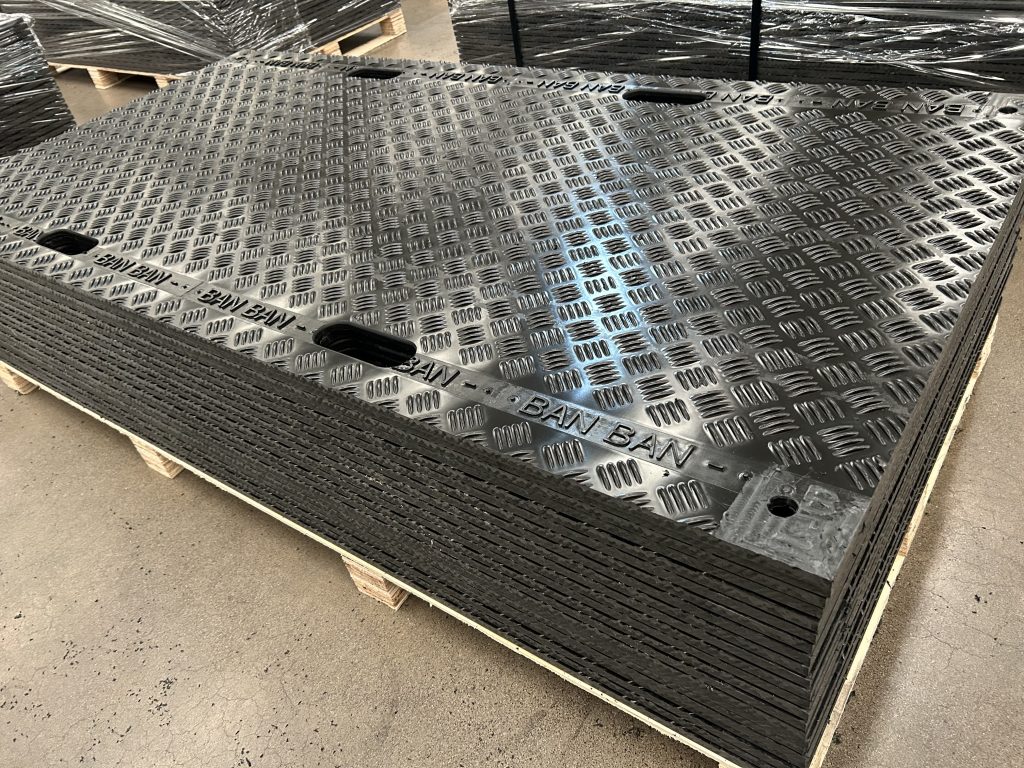
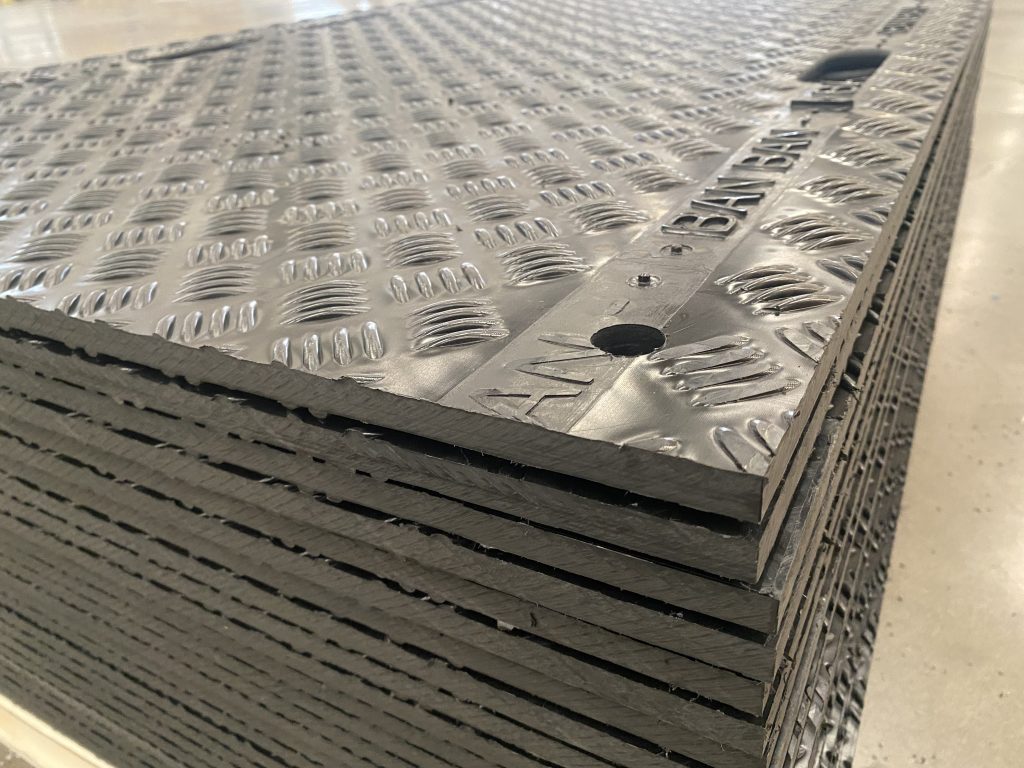
Tread depth affects safety more than any other detail. Look for a pattern molded or embossed at least 1.5 mm deep, present on both sides. Diamond, pyramid and raised-button patterns all work well. A cross-hatched pattern channels water away from the contact area.
Edge design matters too. A chamfered or tapered edge lets tires roll onto the mat without a hard bump and reduces the chance of a wheel catching the lip. Perimeter turn holes serve two purposes. Crews use them as handles, and connector links pass through them to lock panels into a continuous roadway.
Specifications Worth Confirming Before You Order
Ask any supplier for these details in writing:
- Resin type and whether the sheet uses virgin or recycled material
- Density, typically 0.94–0.96 g/cm³
- Actual thickness tolerance, not just a nominal figure
- Tread depth and whether both faces are textured
- UV stabilizer content and warranty period
- Turn hole count, position and reinforcement
- Weight per panel, for shipping and manual handling planning
- Molecular weight grade, since UHMW-PE offers higher abrasion resistance at higher cost
Zhihong Plastics has extruded polyethylene sheet at Wuqiao County, Cangzhou since 2012, supplying more than twenty provinces and export markets across Southeast Asia. Panels ship cut to size, with or without pre-drilled turn holes, in black, green, grey or custom colors. See the full HDPE ground protection mat specification range for thickness options and load guidance.
For panel sizes, thicknesses and load ratings across the range, see our ground protection mats 4×8 supplier page.



