

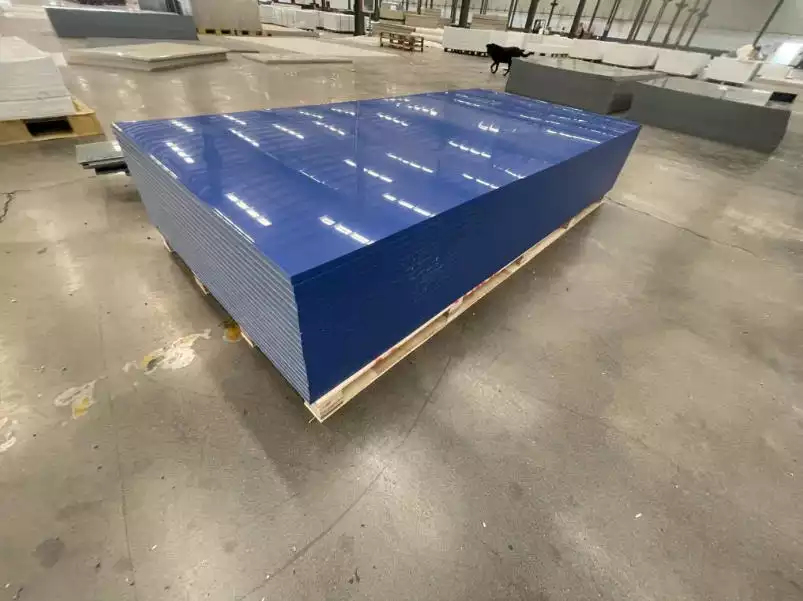
Ultra-high molecular weight polyethylene (UHMW-PE, also written UHMWPE or UPE) is one of the few plastics that engineers routinely choose to replace steel, bronze, and nylon in punishing industrial environments. Knowing UHMW material properties is the difference between a wear part that lasts five years and one that fails in five months. This guide breaks down the mechanical, thermal, chemical, and electrical behavior of UHMW, compares it with HDPE and PP, and explains how to translate those numbers into real design decisions.
What Makes UHMW Different from Ordinary Polyethylene?
All polyethylene is built from the same repeating ethylene unit, but chain length changes everything. Standard HDPE has an average molecular weight of roughly 200,000–500,000 g/mol. UHMW-PE has chains between 3.1 million and 10 million g/mol — chains so long that they entangle into a self-reinforcing network.
That entanglement produces two consequences. First, the melt viscosity is enormous, which is why UHMW cannot be injection molded conventionally and is instead ram-extruded or compression-molded into sheet, rod, and tube. Second, energy applied to the surface is distributed along and between millions of interlocked chains rather than breaking bonds locally. This is the structural reason UHMW outperforms almost every other thermoplastic in abrasion and impact.
Typical UHMW Property Data Sheet
|
Property |
Typical Value (virgin UHMW-PE) |
Test Method |
|
Average molecular weight |
3.1 – 9.2 million g/mol |
ASTM D4020 |
|
Density |
0.93 – 0.94 g/cm³ |
ASTM D792 |
|
Tensile strength at yield |
17 – 25 MPa |
ASTM D638 |
|
Tensile strength at break |
30 – 45 MPa |
ASTM D638 |
|
Elongation at break |
250 – 500 % |
ASTM D638 |
|
Izod impact (notched, 23 °C) |
No break |
ASTM D256 |
|
Hardness |
Shore D 62 – 68 |
ASTM D2240 |
|
Coefficient of friction (dynamic, on steel) |
0.10 – 0.22 |
ASTM D1894 |
|
Abrasion resistance (sand-slurry, HDPE = 100) |
350 – 500 |
ASTM D4060 / ISO 15527 |
|
Melting point |
130 – 136 °C |
DSC |
|
Continuous service temperature |
−269 °C to +80 °C (short peaks 100 °C) |
— |
|
Coefficient of thermal expansion |
1.5 – 2.0 × 10⁻⁴ /K |
ASTM D696 |
|
Water absorption (24 h) |
< 0.01 % |
ASTM D570 |
|
Dielectric strength |
45 – 50 kV/mm |
ASTM D149 |
|
Volume resistivity |
> 10¹⁵ Ω·cm |
ASTM D257 |
Values vary with molecular weight grade, filler package, and sheet thickness, so always request a certified data sheet for the exact grade you are specifying.
The Five Properties That Actually Sell UHMW
-
Abrasion resistance that beats carbon steel
In sand-slurry and dry-particulate testing, UHMW typically outwears carbon steel by a factor of 6–10 and outperforms HDPE by 4–5 times. This is the single most cited reason for using UHMW in chute liners, hopper linings, truck-bed liners, coal and ore transfer points, and grain-handling equipment. Importantly, abrasion resistance rises with molecular weight — a 9-million-grade liner will noticeably outlast a 3-million-grade one in the same chute.
-
Extremely low coefficient of friction
With a dynamic COF of roughly 0.10–0.22 against polished steel, UHMW behaves almost like a self-lubricating bearing material. It is non-stick and hydrophobic, so wet coal, damp sugar, fertilizer, and wood chips slide instead of bridging. Designers use this property in conveyor wear strips, guide rails, star wheels, chain guides, and food-industry idlers where oil or grease would be a contamination risk.
-
Impact strength that does not disappear in the cold
Notched Izod testing on UHMW normally reports “no break,” and the material retains ductility down to cryogenic temperatures (−269 °C). Where PP turns brittle below 0 °C and even HDPE loses toughness in deep winter, UHMW ground-protection panels, ice-rink dasher backings, and cold-store liners keep absorbing shock. That toughness also means UHMW deadens sound and vibration — chute liners noticeably quieten a transfer point.
-
Broad chemical inertness
UHMW resists most acids, alkalis, salt solutions, alcohols, detergents, and aqueous solutions at ambient temperature. It absorbs virtually no water, so dimensions stay stable in wet service — a decisive advantage over cast nylon, which swells and loses strength when saturated. Its limits are strong oxidizers (concentrated nitric acid, fuming sulfuric acid), aromatic and chlorinated hydrocarbons at elevated temperature, and prolonged unprotected UV exposure unless carbon-black or UV-stabilized grades are used.
-
Hygienic, non-toxic, low-maintenance
Virgin UHMW is odorless, tasteless, and available in FDA/EU 10/2011-compliant grades, making it standard for food-contact cutting boards, dairy and brewery guides, meat-processing wear parts, and pharmaceutical handling components. Its non-porous surface will not harbor bacteria the way wood does, and it needs no painting, coating, or lubrication.
Where UHMW Reaches Its Limits
An honest properties discussion includes the weaknesses:
- Low stiffness and creep under sustained load.Flexural modulus is only about 700–900 MPa, and UHMW cold-flows under continuous compressive stress. Load-bearing designs need backing plates, ribs, or generous safety factors.
- Modest temperature ceiling.Above roughly 80 °C, strength drops quickly; above 136 °C the material melts.
- High thermal expansion.At 1.5–2.0 × 10⁻⁴ /K, a 2,400 mm liner panel can grow several millimeters across a 40 °C swing. Use oversized bolt holes and countersunk fasteners with slip clearance.
- Difficult to bond and weld.Its non-polar, low-surface-energy skin resists adhesives; mechanical fastening, welded studs, or flame/corona treatment are the practical routes.
- Not machinable to tight tolerances without care.Stress relief and sharp, high-rake tooling matter; expect springback.
UHMW vs. HDPE vs. PP — Choosing Correctly
|
Criterion |
UHMW-PE |
HDPE |
PP |
|
Abrasion resistance |
Outstanding |
Good |
Fair |
|
Impact at −30 °C |
Outstanding |
Good |
Poor |
|
Stiffness |
Low |
Moderate |
Higher |
|
Max service temp |
~80 °C |
~70 °C |
~100 °C |
|
Chemical resistance |
Excellent |
Excellent |
Excellent (better vs. acids at heat) |
|
Machinability |
Good |
Excellent |
Good |
|
Relative cost |
Highest |
Moderate |
Lowest |
A practical rule: choose UHMW when wear, sliding friction, or impact dominates; choose HDPE sheet when you need general-purpose corrosion resistance, fabrication ease, and lower cost; choose PP when service temperature or chemical attack at heat is the driver. Many plants combine all three across a single processing line. If you are still mapping out material families, this overview of engineering plastic sheet options is a useful starting point.
Design and Fabrication Tips
- Machining:Use high-rake, razor-sharp carbide tooling, high spindle speed, and moderate feed. Air or water cooling prevents gumming. Avoid clamping distortion — UHMW is soft and marks easily.
- Fastening:Countersink and use flat-head bolts with oversized or slotted holes to accommodate expansion. Never over-torque.
- Liner thickness:10–15 mm is typical for moderate abrasion; 20–40 mm for heavy ore and rock impact zones.
- Grade selection:Add carbon black for outdoor UV service, oil-filled or graphite-filled grades to lower friction further, glass-bead or ceramic-filled grades to raise stiffness and reduce creep, and antistatic grades for dust-explosion-risk environments (surface resistivity below 10⁶ Ω).
- Weight budgeting:Because density is close to 0.94 g/cm³, a 2,000 × 1,000 × 20 mm sheet weighs roughly 37.6 kg. Our plastic sheet weight calculator makes freight and handling estimates fast.
Frequently Asked Questions
1. Is UHMW the same as UPE?
Yes — UPE is the common Asian abbreviation for ultra-high molecular weight polyethylene sheet.
2. Will UHMW float?
Yes. At 0.93–0.94 g/cm³ it is lighter than water, useful for marine fenders and floating structures.
3. Does UHMW need UV protection?
For outdoor service beyond a year or two, specify a carbon-black or UV-stabilized grade to prevent surface chalking and embrittlement.
4. Can UHMW be recycled?
Yes, mechanically. Regrind is commonly blended into non-critical liners, though virgin material is recommended where wear life or food contact matters.



