

Polyethylene sheet is one of the most widely used engineering plastics in the world, yet many buyers still ask a simple question before placing an order: what exactly is it, and how do I choose the right grade? This guide explains what polyethylene sheet is, how it is made, how the major grades differ, and where it delivers the best value in real industrial service.
What Is Polyethylene Sheet?
Polyethylene sheet is a solid, flat plastic panel produced by melting polyethylene resin and forming it into a continuous slab, usually through extrusion or compression moulding. Polyethylene (PE) itself is a thermoplastic polymer made from ethylene monomer. Because the polymer chains can be packed at different densities and molecular weights, manufacturers can tune the finished sheet for hardness, impact strength, wear resistance or flexibility.
In practical terms, a polyethylene sheet is a semi-rigid board that can be cut, drilled, routed, welded and thermoformed like wood or metal plate, but with a very different property profile: it does not rust, does not rot, absorbs almost no water, resists most acids and alkalis, and keeps its toughness at sub-zero temperatures.
The three families you will encounter most often are:
- LDPE (low-density polyethylene)– softer, more flexible, density around 0.91–0.93 g/cm³. Used where cushioning and formability matter more than rigidity.
- HDPE (high-density polyethylene)– the workhorse grade, density around 0.94–0.96 g/cm³, rigid, strong and easy to machine.
- UHMW-PE (ultra-high molecular weight polyethylene)– molecular weight above 3 million, outstanding abrasion resistance and impact strength, extremely low friction.
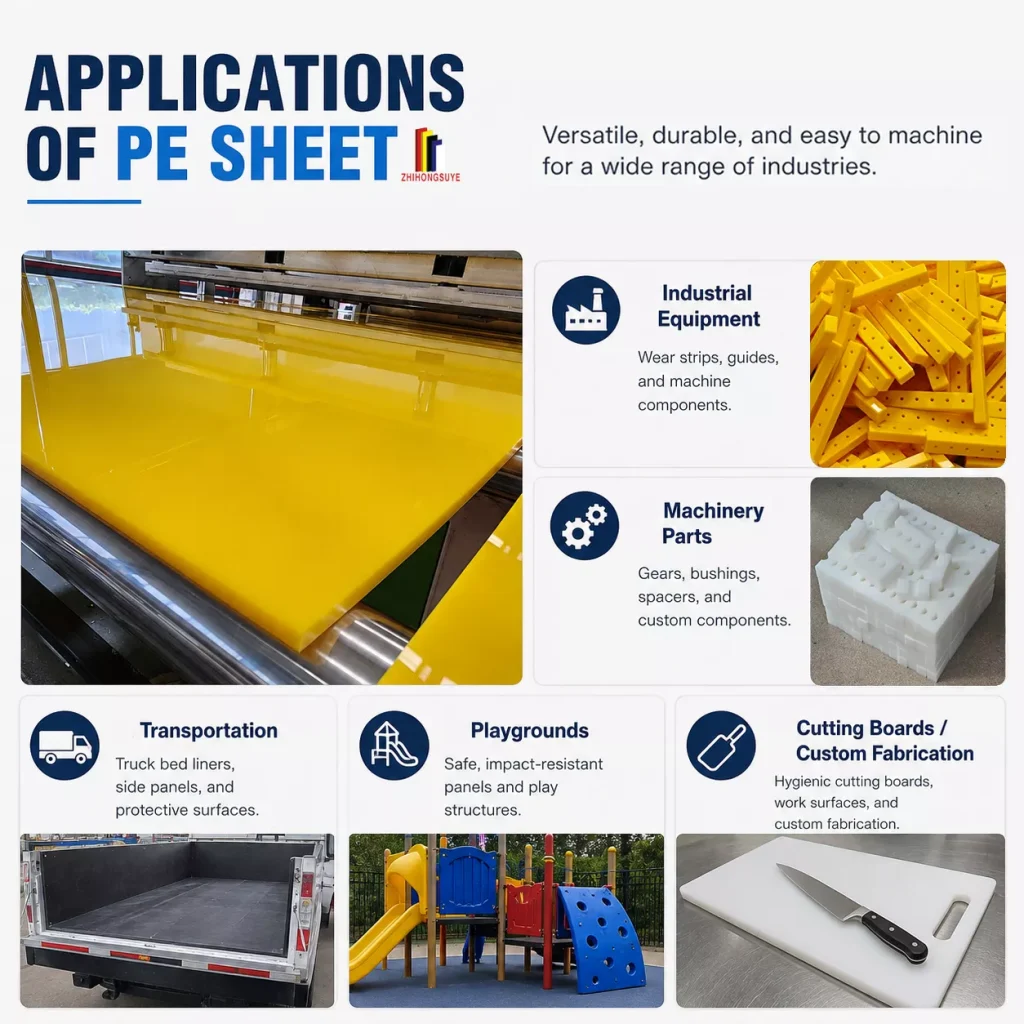
High Density Polyethylene Sheets: The Industry Standard
When people talk about industrial plastic board, they usually mean high density polyethylene sheets. HDPE has a tightly packed, highly crystalline molecular structure, which gives it a stiffness-to-weight ratio that suits structural and semi-structural work.
Typical properties of a high density polyethylene HDPE sheet:
|
Property |
Typical value |
|
Density |
0.94–0.96 g/cm³ |
|
Tensile strength |
22–31 MPa |
|
Service temperature |
–50 °C to +80 °C |
|
Water absorption |
< 0.01 % |
|
Shore D hardness |
60–65 |
|
Coefficient of friction |
0.20–0.25 |
Those numbers translate into practical benefits. The near-zero water absorption means an HDPE panel will not swell, delaminate or breed bacteria, which is why it dominates food processing, marine and sanitary applications. The low friction coefficient means bulk material slides across it instead of sticking, making it ideal for hopper linings, chutes and truck bed liners. And because HDPE is chemically inert, it stands up to salts, detergents, dilute acids and most solvents without stress cracking.
HDPE also comes in specialised versions: PE100 pressure-grade sheet for welded tank fabrication, UV-stabilised marine grade board for outdoor furniture and dock hardware, dual-colour or colour-core sheet for engraved signage, textured sheet for anti-slip surfaces, and flame-retardant grades for enclosed environments.
How Polyethylene Sheet Is Manufactured
Two processes dominate.
Extrusion. Resin pellets are melted in a screw extruder, pushed through a flat die, then calibrated and cooled between polished rollers. Not only does extrusion run quickly and economically, but it also yields excellent surface finishes and tight thickness tolerances. For this reason, industry professionals choose this method for thicknesses from roughly 1 mm to 60 mm and utilize it to manufacture most commercial HDPE and PP boards.
Compression moulding (ram extrusion for UHMW). Powder is loaded into a heated press and consolidated under pressure. This route suits very thick plates and ultra-high molecular weight material that will not flow easily through a die.
Sheet quality depends heavily on process control: melt temperature uniformity, roller pressure, cooling rate and internal stress relief. Poorly relieved stress is the main reason a cheap board warps after machining. Reputable manufacturers anneal their product and hold thickness tolerance within ±5 %, so plates stay flat when routed or CNC-cut.
Polyethylene Sheets 4×8: Why This Size Dominates
Ask any distributor which format moves fastest and the answer is polyethylene sheets 4×8 — 4 feet by 8 feet, or roughly 1220 × 2440 mm. There are good reasons this dimension became a global default:
- Compatibility with existing workflows.Plywood, MDF and steel plate are sold in the same footprint, so 4×8 polyethylene sheets drop straight into fabrication shops without redesigning cutting tables or jigs.
- Efficient nesting.Most cabinet panels, liner sections and cutting board blanks nest well within a 4×8 area, minimising offcut waste.
- Handling and freight.A 4×8 panel fits standard pallets and container widths, which keeps shipping cost per square metre low.
Thicknesses commonly stocked in this size run from 2 mm up to 50 mm, with 6 mm, 10 mm, 12 mm, 15 mm, 20 mm and 25 mm being the highest-volume options. Larger formats such as 1500 × 3000 mm and 2000 × 4000 mm are available from extrusion lines with wider dies, which reduces the number of welded seams in tank and silo linings. If you are sizing an order, remember that weight scales directly with thickness: a 4×8 HDPE sheet at 10 mm weighs approximately 27 kg, while the same panel at 25 mm approaches 68 kg. You can find full stock listings and tolerance data for HDPE plastic sheets 4×8 before finalising a specification.
Where Polyethylene Sheet Is Used
The breadth of application is remarkable for a single material family:
- Material handling– chute liners, hopper and bunker linings, conveyor wear strips, star wheels and guide rails.
- Food and beverage– cutting boards, work surfaces, tank baffles and processing components that meet food-contact requirements.
- Marine– dock bumpers, boat hatches, rub rails, fish holds and UV-stabilised marine board furniture.
- Water treatment and chemical plants– tank fabrication, scraper blades, weir plates, secondary containment.
- Construction and civil works– ground protection mats, crane outrigger pads, concrete formwork facing, geomembrane sheeting.
- Agriculture and aquaculture– livestock pen dividers, fish tank panels, feed bin liners.
- Signage and interiors– colour-core sheet engraved to reveal a contrasting layer, playground panels, locker and partition systems.
Each of these environments plays to a different strength: abrasion resistance for chutes, hygiene for food work, UV stability for marine, and impact toughness for ground mats. A deeper breakdown of application-specific selection criteria is covered in this guide to polyethylene sheet uses.
Choosing the Right Polyethylene Sheet
Work through five questions before you buy:
1. What is the load and wear condition?
Sliding abrasion favours UHMW. Structural stiffness with moderate wear favours HDPE. Gentle cushioning favours LDPE.
2. What temperature range?
Standard HDPE tops out near 80 °C continuous. Above that, consider polypropylene (up to about 100 °C) instead.
3. Is it outdoors?
Unmodified PE degrades under prolonged UV exposure. Specify carbon-black or UV-stabilised grades for anything exposed to sunlight for years.
4. Are there fire regulations?
Enclosed transport, mining or public buildings often require flame-retardant grades meeting UL94 V-0 or equivalent standards.
5. How will it be fabricated?
>>>>>>>>>>>>>>>>>Polyethylene machines beautifully with woodworking tools but cannot be glued reliably — it is joined by hot-plate or extrusion welding, or mechanically fastened with allowance for thermal expansion, which is roughly ten times that of steel.
If you are budgeting a project, our cost of HDPE sheets guide covers material, size, and quantity pricing.
Deep-Dive Technical Notes
HDPE Sheet Chemical Resistance Testing: Methods And Standards
Which Chemicals Are HDPE Sheets Resistant?
HDPE sheet chemical resistance testing ensures its durability in harsh situations. HDPE sheets resist hydrocarbons like oils and fuels. They also work well with industrial oxidizing agents. Due to its molecular structure, HDPE resists chemical penetration. HDPE sheet solvent compatibility analysis shows that it can withstand a wide range of solvents without degrading. PE100 sheet corrosion resistance testing proves its durability in acids and alkalis. HDPE and PE100 sheets are good for chemical-resistant applications because they retain their structural integrity. Even after extensive exposure, HDPE sheet chemical degradation analysis shows low chemical breakdown. PE100 sheet chemical permeability testing reinforces this stability by preventing chemical infiltration. These qualities make HDPE sheets a solid alternative for sectors that need chemically resistant materials.
How Is HDPE Chemical Resistance Tested?
Standardized methodologies assess HDPE sheet chemical resistance. HDPE sheets are immersed in acids, alkalis, and solvents to test tensile strength. These chemical durability tests guarantee the sheets meet industry standards. Additionally, HDPE sheet chemical degradation analysis detects breakdowns from prolonged severe environment exposure. This research helps manufacturers and engineers choose HDPE sheets for specific applications. The material's structural integrity against harsh chemicals is tested in PE100 sheet chemical stability testing. This technique checks oxidizing agent resistance and chemical permeability to ensure the sheets resist chemical penetration. To evaluate sheets' long-term performance, testing methods imitate real-world conditions including temperature and pressure. These thorough examinations confirm HDPE sheets' chemical resistance and give important data for enhancing their use in industrial and commercial applications.
Are HDPE Sheets Acid- and Base-Resistant?
HDPE sheet chemical resistance testing shows good resistance to acids and bases. HDPE sheet acid resistance evaluation shows that the material can survive sulfuric and hydrochloric acids without degrading. PE100 sheet alkali resistance testing shows its resilience against salt and potassium hydroxide. HDPE and PE100 sheets remain structurally sound in acidic or basic conditions because to these qualities. HDPE sheets withstand acids, bases, and other chemicals for several reasons. The dense, impermeable molecular structure of HDPE protects it from chemical attack. Chemical exposure concentration and temperature also affect material performance. High temperatures or concentrated liquids may accelerate chemical reactions. To ensure dependable performance under different settings, HDPE sheet chemical exposure durability testing accounts for these aspects. PE100 sheet chemical permeability testing also shows the material's chemical absorption resistance.
What Affects HDPE Sheet Chemical Resistance?
HDPE sheets' chemical resistance depends on many factors, thus they must be tested under specified conditions. HDPE sheet chemical exposure durability varies on chemical kind, concentration, and time. Highly concentrated acids or alkalis may hasten material breakdown, although diluted solutions may not. PE100 sheet chemical permeability testing ensures the sheets' structural integrity over time. This testing is important for applications involving prolonged chemical exposure. Environmental factors also affect HDPE sheet chemical resistance. Higher temperatures accelerate chemical reactions and deterioration. The density and molecular structure of HDPE also affect its chemical resistance. Higher-density HDPE resists hydrocarbons and oxidizers better. PE100 sheet chemical stability testing ensures that the material meets durability and reliability standards in various conditions. These studies determine HDPE sheet uses that ensure their efficacy in harsh chemical environments.
Beyond grades and sizes, the chemical resistance of HDPE is what makes it the default liner and tank material in corrosive service.
Can HDPE Sheets Handle Solvents?
Chemical resistance testing shows that HDPE sheets can tolerate several solvents. HDPE sheet solvent compatibility analysis assesses its resistance to alcohols, ketones, and hydrocarbons. HDPE's thick molecular structure prevents solvent penetration. HDPE sheet resistance to hydrocarbons makes it useful in oil and fuel conditions. Solvent exposure testing simulates real-world circumstances for durability and reliability. HDPE sheets are immersed in certain solvents for lengthy periods and monitored for weight, tensile strength, and elongation. PE100 sheet chemical permeability testing evaluates the material's solvent absorption resistance. Temperature and pressure affect material-solvent interaction, hence they are evaluated during testing. HDPE sheets are suited for demanding industrial and commercial situations since manufacturers thoroughly test them for solvent resistance.
For buyers weighing HDPE against other polyethylene grades, our custom plastic fabrication guide explains the material options and fabrication methods available.
HDPE Sheet for Chemical Processing Applications
Why is the HDPE Sheet for Chemical Processing the Industry Standard?
The chemical processing industry presents some of the most aggressive environments on the planet. Materials used in these facilities are constantly subjected to strong acids, concentrated bases, organic solvents, and varying temperature fluctuations. Here is why the HDPE sheet for chemical processing outperforms traditional materials like stainless steel, fiberglass, and standard PVC: Exceptional Chemical Resistance: HDPE is naturally resistant to a vast spectrum of chemical agents. It can safely handle highly corrosive chemicals, including sulfuric acid, sodium hydroxide, and various chlorides, without degrading, swelling, or losing mechanical strength. Zero Corrosion and Rot: Unlike metals, HDPE does not rust. It requires no protective coatings or galvanization, significantly reducing maintenance costs over the lifespan of the chemical processing equipment. High Impact Strength: HDPE sheets exhibit incredible toughness. They can withstand heavy impacts, accidental drops, and mechanical stress without cracking or shattering, even in sub-zero temperatures. Superior Weldability and Fabrication: HDPE sheets can be easily cut, machined, and welded using hot gas extrusion or butt welding techniques. This allows engineers to fabricate complex, leak-proof custom tanks, scrubbers, and piping systems tailored to specific chemical processing needs. Moisture and Water Resistance: With a moisture absorption rate of nearly zero, HDPE does not swell or warp when submerged, making it ideal for fluid processing and aqueous chemical storage. High-Density Polyethylene (HDPE) plays a crucial role in modern chemical processing facilities, providing leak-proof and corrosion-resistant containment.
Core Applications of HDPE Sheets in Chemical Plants
The versatility of the HDPE sheet for chemical processing allows it to be deployed across a multitude of critical applications within an industrial plant. Understanding these applications can help facility managers and procurement specialists select the exact grade and thickness required for their projects.
1. Chemical Storage Tanks and Vessels
Perhaps the most common use of HDPE in this sector is the fabrication of bulk storage tanks. Because HDPE does not react with stored chemicals, it ensures the purity of the chemicals while preventing dangerous leaks. It is widely used for storing agricultural chemicals, water treatment coagulants, and industrial acids.
2. Secondary Containment Systems
Environmental regulations strictly mandate that chemical processing plants have secondary containment measures to catch spills or leaks from primary tanks. HDPE sheets are welded together to line concrete containment pits, providing an impermeable barrier that protects the surrounding soil and groundwater from contamination.
3. Fume Scrubbers and Exhaust Systems
Chemical processing often releases corrosive vapors and fumes. Exhaust hoods, ductwork, and fume scrubbers fabricated from HDPE sheets are highly effective because they resist the corrosive condensation that typically destroys galvanized metal ducting.
4. Machined Pump and Valve Components
Heavy-duty HDPE plates can be CNC machined into intricate parts such as pump housings, valve bodies, and flanges. These components provide frictionless, wear-resistant, and chemically inert solutions for fluid transfer systems.
Fabrication and Maintenance in Chemical Plants
One of the main reasons engineers specify the HDPE sheet for chemical processing is its remarkable ease of fabrication. Unlike specialized alloys that require complex and dangerous welding procedures, HDPE can be efficiently welded using thermoplastic extrusion or hot gas welding. This creates seamless, incredibly strong joints that eliminate the risk of chemical leaks at the seams. Furthermore, maintaining HDPE infrastructure is highly cost-effective. Because the material does not corrode, there is no need for regular painting, rust-removal, or protective coating applications. The smooth, non-stick surface of HDPE also resists the buildup of scale and chemical residue, making cleaning cycles faster and less labor-intensive. The safety, efficiency, and longevity of a chemical processing plant rely heavily on the integrity of its materials. The HDPE sheet for chemical processing continues to prove itself as an indispensable asset, providing unmatched resistance to corrosive agents, brilliant mechanical toughness, and long-term cost savings over traditional metals. Whether you are designing a new secondary containment system, fabricating custom chemical storage tanks, or replacing outdated ductwork, Zhihong Plastics has the precise material grade you need. From our rugged PE100 sheets to our high-temperature Polypropylene variants, we supply the building blocks for modern industrial safety.
What Is High Density Polyethylene HDPE
How HDPE Compares With LDPE and UHMWPE
All polyethylene grades share the same building block. The difference lies in chain structure and molecular weight. LDPE has many branches. Those branches keep the chains apart, so the material stays soft and flexible. It works well for film and squeeze bottles, but it dents easily. HDPE has almost no branching. It is rigid, holds its shape under load, and machines cleanly. Tensile strength runs around 22 to 31 MPa depending on grade. UHMWPE takes molecular weight much further, often above 3 million g/mol. Wear resistance becomes extraordinary. It slides better than steel and outlasts HDPE in abrasive service. The trade-off is cost and harder processing. PE100 sits inside the HDPE family as a high-performance pressure grade. It carries a minimum required strength of 10 MPa over 50 years at 20 °C. Pipe makers rely on it, and so do fabricators who want extra long-term stress crack resistance from a flat panel.
Properties That Make HDPE Sheets Useful
A polyethylene sheet is not chosen for looks. It is chosen because of a specific set of numbers. Chemical resistance. HDPE handles salt solutions, caustic soda, hydrochloric acid, detergents and most solvents at room temperature. Strong oxidizers and hot aromatic hydrocarbons are the main exceptions. Moisture behavior. Water absorption is under 0.01%. Panels do not swell, rot or delaminate. Plywood cannot make that claim. Impact strength at low temperature. HDPE stays tough down to roughly −50 °C. Ground mats and truck bed liners keep working through winter. Low friction. The coefficient of friction runs about 0.20 to 0.25 against steel. Coal, sand, grain and wood chips slide instead of sticking. Hopper liners and chute liners depend on that. Electrical insulation. Dielectric strength is high and the material is non-conductive. That suits switchgear spacers and cable protection covers. Food contact safety. Virgin HDPE meets FDA and EU food contact standards. Cutting boards and food processing tables are common applications. Recyclability. HDPE carries resin code 2. Scrap, trim and offcuts go back into the loop. Buyers with sustainability targets like that. The weak points deserve mention too. HDPE has a fairly high thermal expansion rate, near 0.0002 per °C. Long panels need slotted fastener holes. Unstabilized material also degrades under UV, which is why outdoor grades are compounded with 2% to 2.5% carbon black or hindered amine stabilizers. Surface energy is low, so adhesives rarely hold well. Welding, riveting or bolting works better than glue.
How High Density Polyethylene Sheets Are Manufactured
Two methods dominate. Compression molding presses powder or granules between heated platens, which produces very thick blocks with low internal stress. Extrusion pushes molten resin through a flat die, then calibrates the web between polished rolls. Extrusion is faster and gives better thickness consistency across the width. It also allows co-extrusion, which is how a two-tone panel gets a colored skin over a contrasting core. Sign makers and playground builders use those color core boards because engraving reveals the second layer. At our plant in Wuqiao County, extrusion lines run HDPE sheet in thicknesses from 1 mm up to 200 mm. Standard widths include 1000 mm, 1220 mm, 1500 mm and 2000 mm. The familiar 4×8 foot format is stocked because North American fabricators design around it. Surface finish is a specification, not an afterthought. Smooth finish suits food handling and machining. Matte or sanded finish helps with printing and bonding. Diamond and mesh textures add grip for walkways, truck floors and ground protection mats.
High Density Polyethylene Uses Across Industries
The list is long, so it helps to group it by what the material is doing. Wear and abrasion. Chute liners, hopper liners, silo liners, conveyor wear strips, dozer blade edges and dump body liners. Material flows and the panel takes the punishment. Water and chemical containment. Tank walls, pickling bath liners, scrubber components, plating shop trays and secondary containment. Fabricators butt-weld panels into custom vessels. Marine and outdoor. Marine grade board becomes hatch covers, rod holders, dock bumpers, boat seat frames and helm station panels. It does not absorb water and never needs paint. Ground protection. Textured HDPE mats spread the load of cranes, drill rigs and utility trucks over soft soil. Crews reuse the same mats across dozens of job sites. Food and hygiene. Cutting boards, fish processing tables, bakery work surfaces and conveyor guide rails. Smooth walls resist bacteria and clean up quickly. Agriculture and livestock. Barn wall cladding, feed bunk liners, manure scraper blades and stall dividers. Playgrounds and site furniture. Color core panels cut into climbing walls, benches, lockers and picnic tables. The color runs through the sheet, so scratches barely show. Machined parts. Bushings, guides, star wheels, gaskets and pump components. HDPE cuts, drills and turns on standard equipment. If you want a deeper breakdown by sector, our guide on polyethylene sheet uses covers thickness selection for each application.
HDPE Sheet Versus PP Sheet
Buyers often weigh these two against each other. Polypropylene has a higher melting point, around 160 °C against 130 °C for HDPE. It handles hot liquids better and resists stress cracking in chemical service. But PP turns brittle near 0 °C and has lower impact strength in cold weather. HDPE wins on toughness, low-temperature performance and wear life. PP wins on heat resistance and rigidity. A pickling tank running at 70 °C should be PP. A grain chute liner in Manitoba should be HDPE.
For a side-by-side breakdown of these two workhorse materials, read our High-Density Polyethylene vs Polypropylene comparison, which covers heat resistance, cold toughness, and fabrication rules.
What to Ask Before You Buy
Not every panel labeled HDPE performs the same. A few questions separate good material from filler-loaded material. 1. Is the resin virgin or regrind? Regrind lowers cost and lowers tensile strength. Ask for a percentage, not a yes or no. 2. What is the actual density? Some suppliers add calcium carbonate to cut resin cost. Density rises above 0.97 g/cm³ and impact strength drops. 3. Is UV stabilization included? Outdoor panels need it. Ask for the additive type and expected service life. 4. What is the thickness tolerance? Good extrusion holds ±5% or better. Loose tolerance causes trouble in CNC nesting and welding. 5. Can you get a material test report? Tensile, elongation, hardness and melt flow index should be documented per batch. 6. What are the flatness and packaging terms? Panels stored badly warp. Ask how they are stacked and shipped. Our PE sheet series covers standard HDPE, PE100 grade, textured, dual-color and flame-retardant options, each with published specifications.
Fabrication Notes for HDPE Panels
Cutting works best with carbide-tipped blades and high rake angles. Feed steadily so the chip clears. Slow feeds melt the cut edge. Drilling calls for sharp bits and modest speed. Coolant is optional but helps on thick stock. Welding is the preferred joining method. Butt fusion, extrusion welding and hot air welding all work. Surfaces must be clean and free of oxidation, so scrape the weld zone first. Thermoforming happens between 130 °C and 180 °C. HDPE has a narrow forming window and shrinks noticeably on cooling, so build shrinkage into the tool. Printing and painting require surface treatment. Flame treatment or corona discharge raises surface energy enough for ink to hold. Storage matters more than people expect. Keep panels flat on a level pallet, out of direct sun, and away from heat sources. Warped stock wastes machine time.
Among the specialised grades, food safe HDPE sheets are specified for FDA-compliant food contact.
For static-controlled packaging and handling, an ESD safe plastic sheet in PE is a common specification — learn the grades in our dedicated article.
Seam joining typically uses a heated-air gun and a plastic welding rod formulated to match the sheet’s resin.
Beyond machining and welding, HDPE sheets can also be shaped by heat — the HDPE thermoforming process is covered step-by-step in our forming guide.
If you are choosing between the two main polyethylene grades, our LDPE vs HDPE guide breaks down the differences.
For a side-by-side of the two most common polyolefins, see our PE vs PP comparison.
To see how polyethylene stacks up against a precision acetal, read HDPE vs acetal.



